Chrome Fixed 1,072 Bugs, Then Changed How Updates Reach Users
Chrome fixed more security bugs in two milestones than in the previous 23 while using AI across discovery, triage and fix preparation.

Google says Chrome 149 and 150 fixed 1,072 security bugs, more than the previous 23 milestones combined. Chrome users and enterprise browser administrators are affected by the operational consequence: finding and shipping fixes faster does not protect a running browser until the update is actually applied.
The Chrome Security Team is responding by automating more of discovery, triage, candidate-fix generation, testing, release notes, and delivery. It is also piloting two security releases per week. For defenders, this is not evidence that 1,072 exploitable flaws suddenly escaped into the wild. Google does not say that. It is evidence that release velocity is outgrowing patch programs that check only whether an update was downloaded.
AI expanded the front half of the pipeline
Google built a Gemini-based agent harness in early 2026 to search the broader Chrome codebase. One finding was a 13-year-old sandbox escape that could let a compromised renderer trick the browser into reading local files. The team says it now runs models repeatedly, supplies them with Chrome’s CVE and Git history, and gives a separate critic agent component-specific security guidance.
Automation continues after discovery. The intake system filters and deduplicates reports, reproduces proofs of concept on affected operating systems and browser versions, attaches stack traces and severity metadata, and routes issues to a human owner. Fixing agents produce candidate patches; a critic evaluates them; test-writing agents exercise supported platforms and configurations. Developers still review the result and can change a severity rating. This is an AI-assisted engineering pipeline, not a claim of unattended patch publication.
The volume change is real. Google says LLMs generate candidate fixes for most vulnerabilities, and the last two milestones fixed 1,072 security bugs. Its integrated DeepMind and Project Zero tools also run every 24 hours across code changes; in May, Google says those checks blocked more than 20 vulnerabilities from reaching production, including one critical S1+ issue.
The patch gap moved toward release and restart
Once a security fix appears in Chromium’s public source tree, attackers can reverse-engineer it while most users remain on Chrome Stable. Google calls this interval the patch gap. It is moving to a two-week cadence for major milestones, retaining weekly security updates, and piloting two security releases per week to shorten that interval.
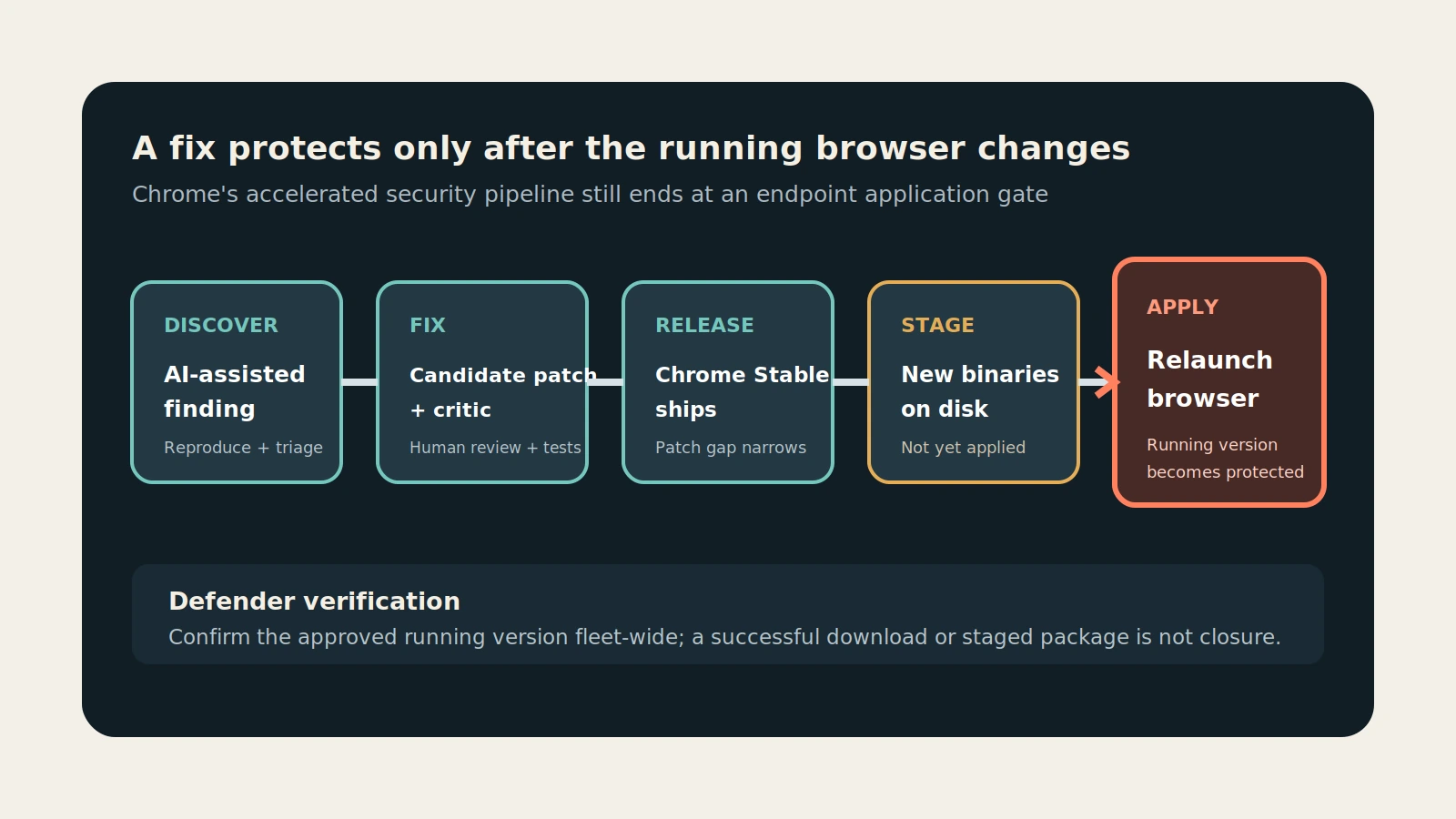
Figure details
A security bug moves through five states: AI-assisted discovery and reproduction; candidate fixes, critic review and testing; merge and Chrome Stable release; download and staging on the endpoint; and application to running browser processes. The first four states can complete while a device remains exposed if Chrome has not relaunched. The defender verifies the running version across the fleet to confirm that the update is active.
The last handoff remains stubborn. Chrome downloads new binaries silently and stages them on disk, but the browser traditionally applies them on restart. Google says triage, fixing, testing, and release can take one or two days, making a delayed restart a significant contributor to N-day risk.
Chrome 150 changed one narrow case on macOS: when the browser has no open windows but continues running in the background, Chrome can detect a pending update and restart automatically. Google is also researching dynamic patching that would replace Renderer and GPU child processes with updated binaries without a full browser restart. That feature is not presented as generally available, so administrators should not count it as a current compensating control.
A bug count is not a severity count
The 1,072 total describes security bugs fixed across two milestones. Google’s post does not state that all were remotely exploitable, critical, or used in attacks. It separately describes a critical S1+ issue stopped before production and a sandbox escape found in old code. Combining those examples into a claim that Chrome shipped 1,072 critical vulnerabilities would be wrong.
The defensive signal is process pressure. By March, Google had received more bug reports than it had during all of 2025. It adjusted its vulnerability reward program toward reports that add to internal findings and fit automated intake. The company is also automating release-note and CVE-description generation. As releases arrive faster, use inventory and deployment telemetry to check which browsers are actually running the fixes.
Verify the Running Browser Version
Set an enterprise relaunch deadline with Chrome’s RelaunchNotification policy, escalating from a prompt to a forced restart within a defined interval. Use Extended Stable only where change-control requirements justify the slower cadence; do not treat it as permission to leave a pending security update unapplied. Track fleet-wide Chrome versions in Chrome Enterprise Core, Premium, or equivalent endpoint inventory, and separate devices that downloaded an update from devices whose running browser version changed.
For each security release, define a compliance target using the fixed Stable version and a deadline appropriate to exposure. Investigate devices that remain on the previous running version after that deadline: look for disabled updates, persistent browser processes, failed relaunches, unsupported operating systems, or policy conflicts. Record an owner and expiry for every exception so long-lived lag remains visible alongside the overall deployment percentage.
Verify that every in-scope endpoint reports the approved running Chrome version and relaunch-required devices have restarted. Record an owner, compensating control, and expiration date for each exception. A cached installer, staged binary, or successful download event alone does not establish protection.
Corrections
- : Corrected a timing statement that previously read 'In March, Google received more bug reports than during all of 2025' and now reads 'By March, Google had received more bug reports than it had during all of 2025,' matching Google's cumulative phrasing.