
Cisco’s August 2026 IOS XE hardening release fixes seven CVEs, including one with a maximum CVSS score of 9.8 and another at 9.0. Cisco states, “There are no workarounds that address these vulnerabilities.” Network teams running the reviewed 17.9, 17.12, 17.15, 17.18, or 26.1 trains should map every IOS XE device to Cisco’s fixed-release table now.
There is no workaround. Cisco lists first-fixed releases for each reviewed train, so the immediate control is a software change followed by fresh version evidence from the running device. Cisco did not report known public exploitation or malicious use when it published the advisory, but that statement does not reduce the need to close devices that sit below a fixed build.
Seven classes share one release
The coordinated hardening release covers seven distinct failure classes. CVE-2026-20272, rated up to 9.8, falls under improper neutralization of special elements. That class can include unsafe handling of commands, operating-system input, or arguments. CVE-2026-20267, rated up to 9.0, is an improper access-control issue that can let an operation exceed the permission boundary intended by the product.
The other five CVEs carry maximum scores of 8.6. CVE-2026-20268 concerns memory-buffer operations. CVE-2026-20269 concerns resource lifetime. CVE-2026-20270 concerns incorrect calculations or numeric conversion. CVE-2026-20271 concerns insufficient control-flow management. CVE-2026-20273 concerns improper input validation.
Those class labels describe the kind of engineering failure. They do not establish that every issue has the same prerequisites, reaches the same component, or is remotely exploitable in every deployment. Cisco’s consolidated record does not provide a public packet trace or working exploit for defenders to replay. Treat the scores and fixed-release table as confirmed; treat more specific attack paths as unknown unless Cisco adds them.
Cisco found the issues during an internal security review using existing testing processes and frontier AI models. The advisory also publishes Snort rule ranges 66897-66898 and 66891-66896 as defensive action links.
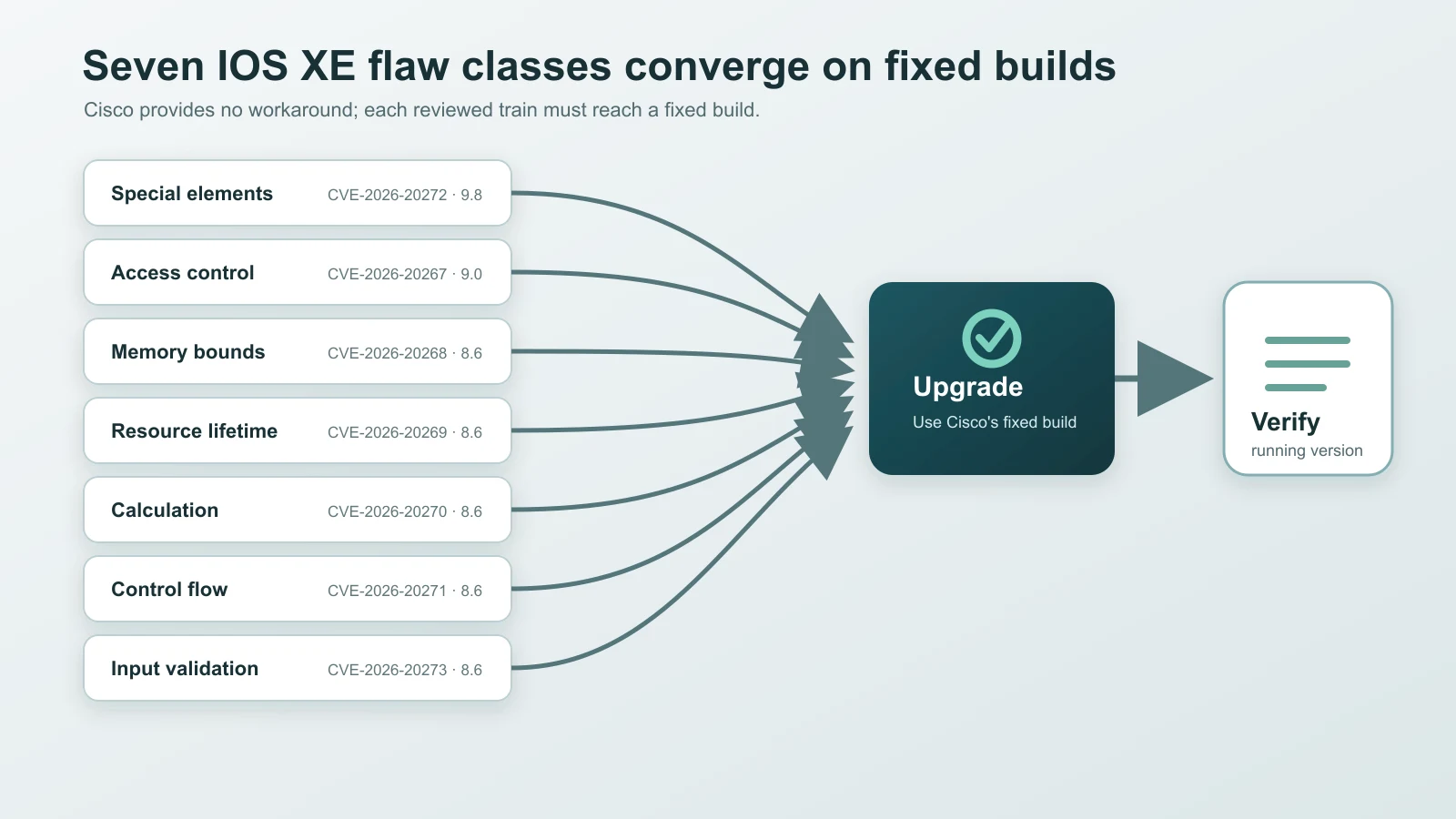
Figure details
Seven lanes represent the vulnerability classes in Cisco's August 2026 IOS XE hardening release: special-element neutralization, access control, memory bounds, resource lifetime, calculation, control flow, and input validation. All lanes converge on the upgrade step. The final checkpoint requires operators to collect the running IOS XE version and compare it with Cisco's first-fixed release for the device's train.
Check release and operating mode
Cisco evaluated IOS XE running in autonomous mode and controller mode across the named trains. Configuration does not provide a substitute for the fixed software in that scope. Catalyst 3650 and 3850 Series Switches were not evaluated because they do not run the reviewed releases. The status of every older train still requires a supported vendor disposition.
The first-fixed targets in the advisory are 17.9.10 for the 17.9 train, 17.12.8 for 17.12, 17.15.6 for 17.15, 17.18.4 or 17.18.4a for 17.18, and 26.1.2 for 26.1. Those builds supersede every earlier build in their listed train for this advisory. A later rebuild is acceptable only when Cisco’s current table or software checker identifies it as fixed. Operators should perform that check at change time because vendor tables can be revised.
Build the inventory from management platforms, configuration archives, asset databases, support records, and active discovery where policy permits. Record model, serial number, operating mode, running version, boot image, redundancy role, management address, business owner, and maintenance dependency. Do not collapse a chassis pair or stack into one row if its members can run different images.
Verify the running image
Stage only Cisco-provided images and verify their checksums through the organization’s software-distribution process. Confirm storage, memory, ROMMON or bootloader dependencies, license state, configuration compatibility, and the supported upgrade path before scheduling the change. For redundant systems, preserve a tested rollback path and make the order of operations explicit.
After reload, collect the version from the running control plane. Confirm that the active image matches the intended fixed release, the boot variable points to the same approved image, peers and line cards returned, routing adjacencies stabilized, and management access remains restricted. An image copied to flash or referenced in a change ticket is not proof that the device is running it.
IOS XE devices often carry routing, switching, wireless, or controller duties that make emergency restarts expensive. Scheduling that work is a maintenance problem. It does not change whether the device is vulnerable. If a device cannot move immediately, isolate its management plane, remove unnecessary exposure, increase logging, and document the exception with a dated upgrade commitment. Those controls reduce opportunity; Cisco does not identify them as workarounds.
Preserve closure evidence
Cisco’s statement that it knew of no exploitation is limited to publication time. It reduces the immediate campaign claim, but it does not establish that an exposed device was untouched before the upgrade. The public advisory also does not provide vulnerability-specific indicators of compromise.
That leaves closure dependent on ordinary device evidence: the before-and-after running state, the change record, and whatever management-plane history the environment retained. Where that history is thin, the article should not turn a successful upload into a clean retrospective finding. It is a software fix unless the retained records can support more.
Verify every running train
Export the IOS XE fleet and split it by hardware model, operating mode, and running release. For each in-scope device, compare the running version with Cisco’s current first-fixed build: 17.9.10, 17.12.8, 17.15.6, 17.18.4 or 17.18.4a, and 26.1.2 for their respective trains. Send unlisted trains and unsupported hardware through a vendor-supported disposition instead of treating “not in the reviewed table” as “not affected.”
Upgrade through the approved path, then collect fresh running-version and boot-variable output. Validate routing, redundancy, line-card, wireless, controller, and management-plane health appropriate to the role. Preserve configuration archives, AAA/accounting, syslog, crash records, and management-plane controls separately from the change record. Confirm each exception has a vendor-supported disposition or removal record.
A complete device table settles the maintenance question. Cisco says there are no workarounds and no known exploitation at publication, which gives operators a clear maintenance obligation but not a retrospective finding. For a below-fixed device with exposed management paths, the old access question belongs to retained telemetry, not the software inventory.