On August 26, the U.S. Cybersecurity and Infrastructure Security Agency placed CVE-2026-8452 in the Known Exploited Vulnerabilities catalog and set an August 29 remediation deadline for federal agencies. The entry covers customer-managed Citrix NetScaler ADC and NetScaler Gateway appliances that expose a Gateway or AAA virtual server.
The sharpest part of the record is also the least settled. Citrix describes the flaw as a memory overflow that can cause unpredictable behavior or denial of service. watchTowr Labs separately turned a SAML heap overflow from the same bundled update into unauthenticated code execution inside NetScaler’s root packet engine. The researchers believe their bug is CVE-2026-8452, but Citrix’s bulletin does not conclusively map each credited finding to a CVE.
Exploitation changes patch order
CISA’s listing establishes active exploitation. It does not identify an attacker, victim, exploit method, or campaign, and it marks known ransomware use as unknown. The agency’s description stays with denial of service; it does not say observed attackers used the root-code-execution path demonstrated by watchTowr.
That distinction keeps the response accurate without making it slower. CVE-2026-8452 carries a three-day federal deadline and a forensic-triage requirement. CISA’s implementation guidance puts scoping and evidence preservation ahead of patching when the operating situation permits, because a firmware change can remove volatile evidence.
The primary sources publish no count of vulnerable appliances, exploit attempts, compromised organizations, or victims. The absence of a public victim total is an evidence gap, not a reason to downgrade an internet-facing access appliance already present in KEV.
SAML input reaches root
watchTowr analyzed a vulnerable NetScaler 13.1 appliance using SAML. The researchers found what they called “an unauthenticated, remotely reachable memory corruption” in nsppe, the packet-processing engine that runs as root.
The path begins while NetScaler canonicalizes the XML SignedInfo block in a SAML message. An attacker can enlarge the PrefixList attribute with unique, space-separated values. Vulnerable builds copy the canonicalized data into a fixed-size global buffer without a sufficient bounds check. An oversized list writes into adjacent packet-engine state, first producing a controlled crash and then giving the researchers the memory control needed for code execution.
The patched 13.1 build adds specific size checks around the copy. That binary difference supports the mechanism. The CVE assignment remains qualified because Citrix bundled six vulnerabilities in one bulletin and did not pair each acknowledgement with one identifier.
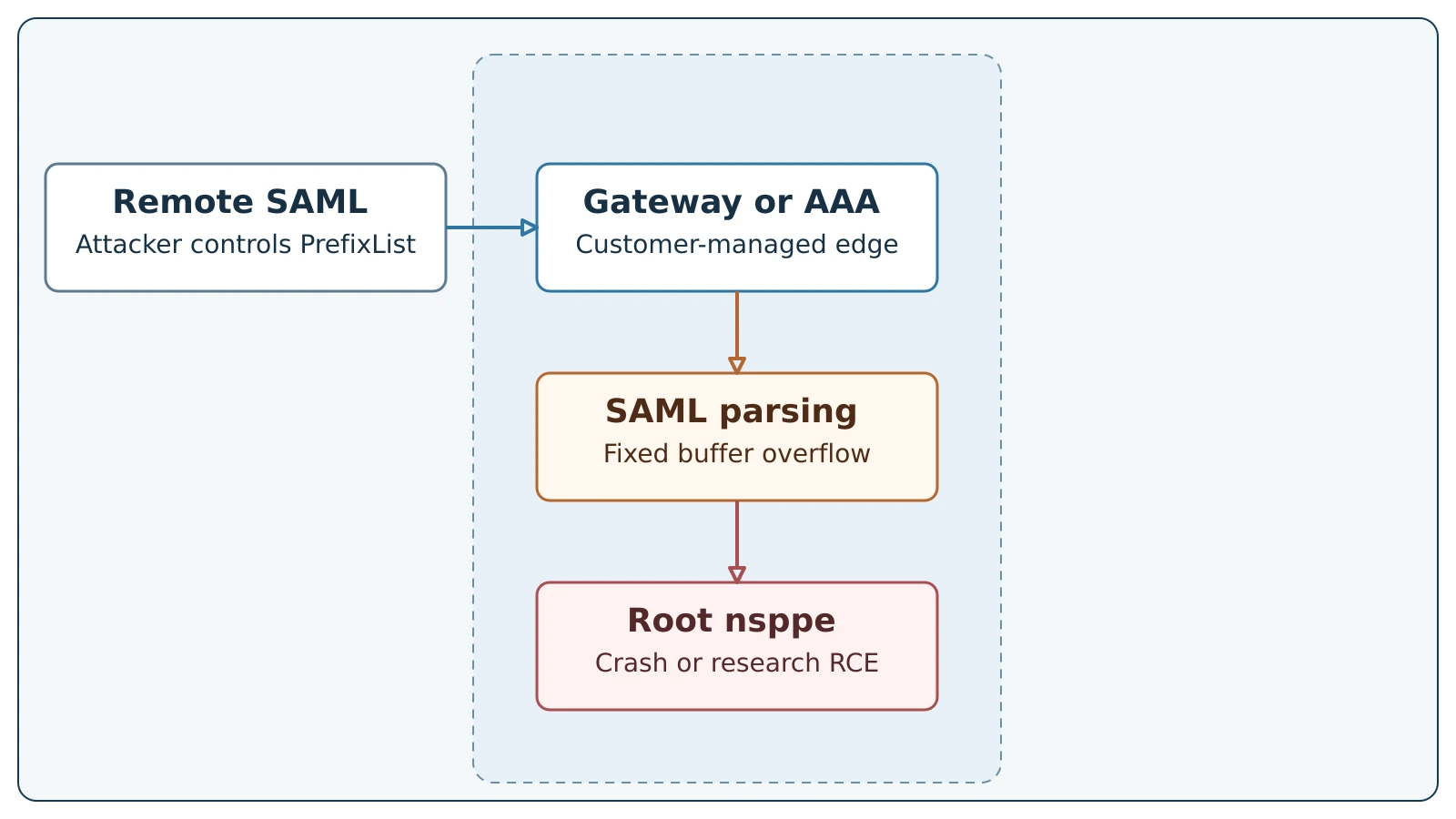
Figure details
A remote request enters a customer-managed NetScaler Gateway or AAA virtual server. In watchTowr's tested SAML configuration, an oversized SignedInfo PrefixList reaches canonicalization and exceeds a fixed global buffer. The overflow corrupts adjacent state in the root nsppe packet engine. Citrix confirms the memory-overflow class and affected Gateway or AAA scope; watchTowr demonstrates a crash and root code execution but treats the CVE-2026-8452 mapping as probable rather than confirmed.
Configuration defines exposure
Citrix’s affected scope is broader than the SAML setup used in the research. Treat the vendor’s preconditions as the inventory boundary: a Gateway instance includes SSL VPN, ICA Proxy, CVPN, and RDP Proxy deployments, while the other condition is an AAA virtual server.
Citrix tells administrators to inspect the running configuration for these entries:
add authentication vserver .*
add vpn vserver .*
The first identifies an AAA virtual server. The second identifies a Gateway virtual server. A SAML profile can help prioritize a research-matching path, but its absence does not remove an appliance from Citrix’s stated CVE-2026-8452 scope.
Customer-managed NetScaler ADC and Gateway 14.1 releases before 14.1-72.61 are affected. The 13.1 line is affected before 13.1-63.18. For regulated builds, the fixed floors are 14.1-72.61 FIPS and 13.1-37.272 for 13.1 FIPS and NDcPP. Later releases in each supported train supersede those fixed builds.
Secure Private Access Hybrid deployments using NetScaler instances also need the update. Citrix says its own managed cloud services and Citrix-managed Adaptive Authentication already received the necessary software updates.
Preserve evidence before upgrades
Start with an inventory export that binds every Gateway and AAA virtual server to its appliance build, exposure, owner, and high-availability peer. Preserve volatile data, the exported configuration, and existing appliance and remote audit records for publicly exposed or suspicious systems before changing firmware, then follow the CISA triage sequence through scoping, evidence collection, patching, containment, and analysis. Look for unauthorized access, persistence, lateral movement, staging, and exfiltration; a successful update cannot attest to what happened beforehand.
Upgrade every in-scope node and peer to the applicable fixed floor or a later supported release. The verification test is two-part: export the post-change configuration and software inventory, then confirm that every add authentication vserver and add vpn vserver entry maps to a node running at or above its fixed train. The expected result is zero exposed Gateway or AAA instances on an affected build, with preserved evidence and a documented triage disposition for each appliance that was exposed before remediation.
NetScaler sits where authentication, remote access, and protected applications meet. A crash-only vendor description and a qualified RCE mapping call for careful language, while CISA’s exploitation finding calls for decisive operations. Defenders need both disciplines at once: preserve the past, remove the vulnerable build, and prove the whole access pair moved.