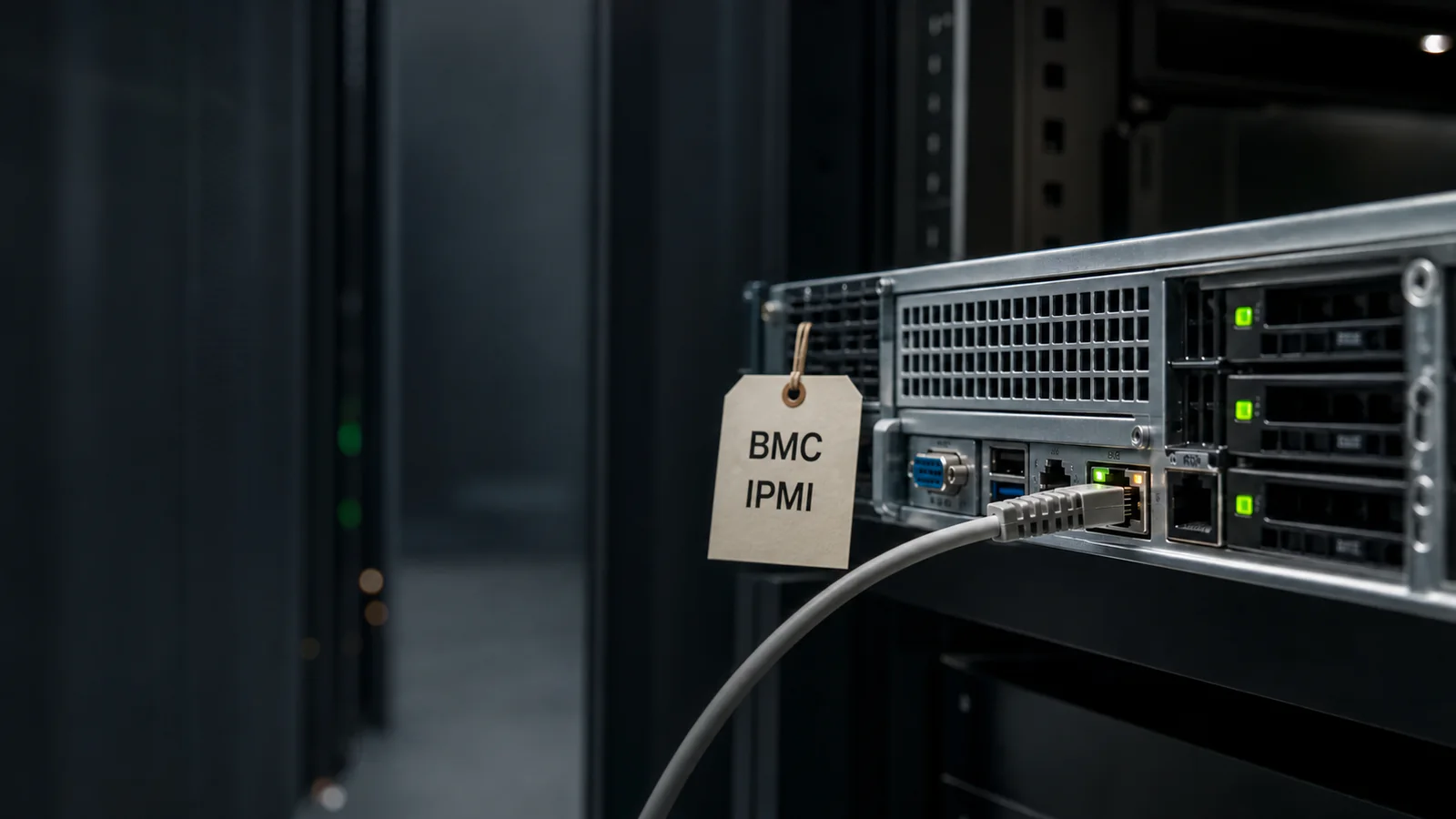
Security researchers found 36,872 server management interfaces exposing IPMI to the public internet. Of those, Lava reports that 24,650 returned at least one password-derived RAKP response before the requesting client had authenticated.
Almost 67 percent of the tested interfaces exposed material that an unauthenticated party could use for offline password guessing. The finding alone does not show that any of those servers were compromised. Lava recovered common passwords for 2,340 named accounts and weak passwords tied to empty usernames on 6,240 systems. The researchers say they did not use recovered passwords to log in.
IPMI sends the cracking target before it trusts the client
The weakness is CVE-2013-4786, a property of the IPMI 2.0 RMCP+ Authenticated Key-Exchange Protocol. During RAKP authentication, a baseboard management controller can return an HMAC-SHA1 value calculated from the account password and session values known to the requester.
An unauthenticated party able to reach UDP port 623 can collect that response and test password candidates locally. The BMC receives one request for the captured exchange, while the guessing occurs elsewhere. Ordinary failed-login thresholds therefore do not describe the full exposure.
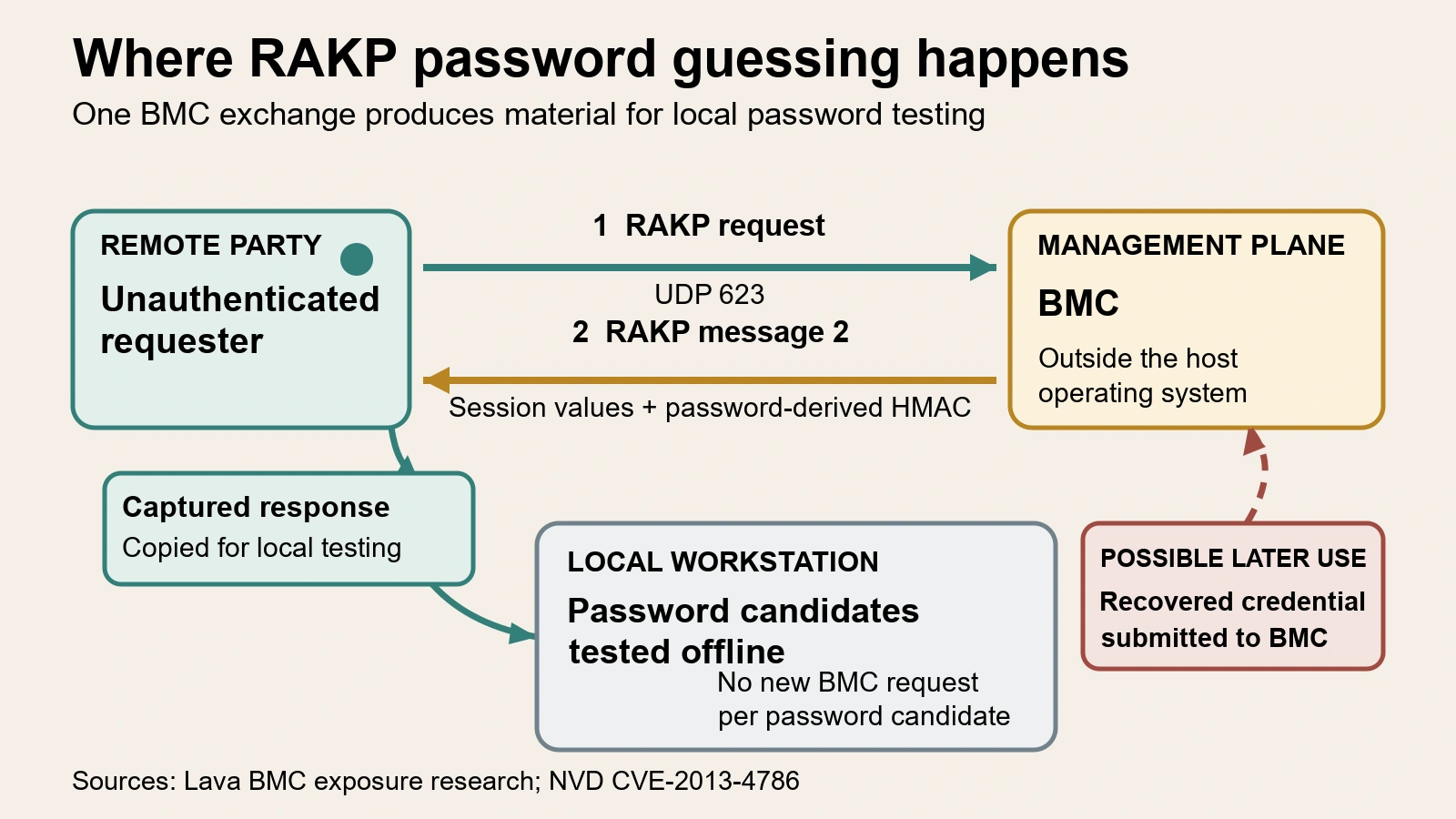
Figure details
An unauthenticated requester starts an IPMI 2.0 RAKP exchange with a BMC over UDP port 623. The BMC returns session values and a password-derived HMAC before client authentication completes. The requester can then test password candidates offline, so repeated guesses do not create repeated BMC login failures. If a password is recovered and later used, the path returns to the BMC as privileged management access. The figure separates confirmed protocol behavior from the possible later use of a recovered credential.
Lava measured the exposure on May 6, 2026, and repeated measurements through July. Its report says an average of 60 previously unseen IP addresses appeared among exposed BMCs each day. More than half of the responding systems appeared to be Supermicro hardware.
The researchers also tested predictable factory-password formats. They recovered the ten-uppercase-letter passwords of two 2023 Supermicro systems operated by a GPU provider whose policy permitted the test. In a lab, they searched the complete eight-character HPE iLO factory-password space in about 32 seconds per captured response on eight RTX 6000 PRO GPUs. Cracking time varies with the password format, hardware, and search method.
BMC access sits below most host defenses
A BMC can power-cycle a server, expose its console, mount virtual media, update firmware, and change low-level platform settings while the host operating system is unavailable. Host endpoint telemetry may not record activity performed through that separate management processor.
Lava found an exposed HPE iLO 4 login page displaying a ransom demand. Its report left the underlying server encryption claim unconfirmed. The altered page confirms access to that management interface, while the claimed effect remains unverified.
The investigation must therefore cover the out-of-band management plane and the host it controls. Removing public exposure prevents another RAKP capture, but it cannot show whether previously exposed credentials were recovered or used.
Vendors are reviewing factory defaults
Lava says it notified affected vendors and operators where it could identify ownership. Supermicro “acknowledged that this is a plausible scenario with modern multi-GPU cracking capabilities,” reiterated that customers should rotate default BMC passwords during setup, and said it “will review possible improvements to the default password policy for future hardware revisions.”
Lava also reported its HPE iLO factory-password findings to HPE. HPE’s Product Security Response Team “confirmed that it is evaluating stronger factory-default password requirements.” HPE also noted that IPMI-over-LAN is disabled by default in newer iLO generations, while hardening remains the customer’s responsibility for the installed base of iLO 4, iLO 5, and iLO 6 systems.
Check BMC Access and Host Integrity
First, inventory every BMC and test from outside the approved administrative network that UDP port 623 and vendor web or API surfaces are unreachable. Disable IPMI-over-LAN where operations do not require it. Dell states that CVE-2013-4786 has no patch and recommends disabling IPMI-over-LAN. Where IPMI must remain, restrict it with an isolated management network and access-control lists.
Second, replace every factory, reused, weak, or potentially exposed BMC credential. Do not treat password rotation as sufficient evidence. Review BMC audit and lifecycle records for successful sessions, account changes, virtual-media mounts, console access, power events, firmware updates, network-setting changes, and cleared logs. Compare firmware and configuration with a trusted baseline, and check bastion, VPN, firewall, DHCP, switch, and network-flow records for unapproved paths to the management network.
Finally, inspect the managed host for changes that could have arrived through console or virtual media, then validate the recovery path. Verify that no public management route remains and only approved administrative systems can reach the BMC. Replace credentials with unique values, compare controller firmware and configuration with trusted state, review management and adjacent network records for unexplained access, and run the host’s known-good integrity check.
Missing BMC logs, unverified firmware, absent flow history, or evidence that audit records were cleared leaves a material blind spot. In that case, rebuild trust at the platform layer with vendor guidance, verified firmware recovery, or hardware replacement where integrity cannot be established.