Attackers are exploiting a critical JFrog Artifactory authentication flaw to create administrator tokens, according to a watchTowr observation reported by SecurityWeek. That act would turn network access to a vulnerable artifact repository into durable administrative control over a service that development pipelines trust to store and distribute software.
The exploitation account has a firm limit: watchTowr is the only organization publicly reporting attacks, JFrog has not confirmed the activity, and neither source quantified victims or attack volume. JFrog has, however, confirmed the underlying capability. Its CVE-2026-82329 advisory says Artifactory, “under default configuration, may allow an unauthenticated attacker with network access to obtain administrative privileges.”
One report changes urgency
JFrog published the critical advisory on August 28. SecurityWeek reported on September 1 that watchTowr had already seen attackers creating administrator tokens. The report gave no request pattern, source addresses, victim count, or evidence that the tokens were used to alter repositories. SecurityWeek said it asked JFrog to confirm the attacks and had not reported a response when its article was captured.
The available evidence therefore supports two different statements. Administrative compromise is a vendor-confirmed capability of the flaw. Active exploitation is a single, attributed telemetry report without independent confirmation or public scale data.
That uncertainty does not reduce the access boundary. CVE-2026-82329 carries a 9.8 CVSS v3.1 score with network access, low attack complexity, no required privileges, and no user interaction. JFrog classifies the weakness as improper authentication. The company has not disclosed the vulnerable endpoint, token format, triggering request, or full bypass sequence.
Default access crosses trust boundaries
Artifactory is a repository manager for packages, binaries, container images, and other artifacts used by build and release systems. Administrative access can reach the identities, permissions, repositories, and distribution decisions that make those artifacts trustworthy to downstream automation.
The public record does not establish that attackers changed packages, stole credentials, or pushed malicious releases through CVE-2026-82329. Those are consequences defenders must assess after suspected administrative access because they sit within the product’s control plane. Treating them as confirmed outcomes would outrun the evidence.
The surprising part is the short path described by the two sources. JFrog documents an unauthenticated path to administrator privileges under the default configuration. WatchTowr’s reported observation ends with newly created administrator tokens. There is no published evidence of a separate credential-theft or privilege-escalation stage between those points.
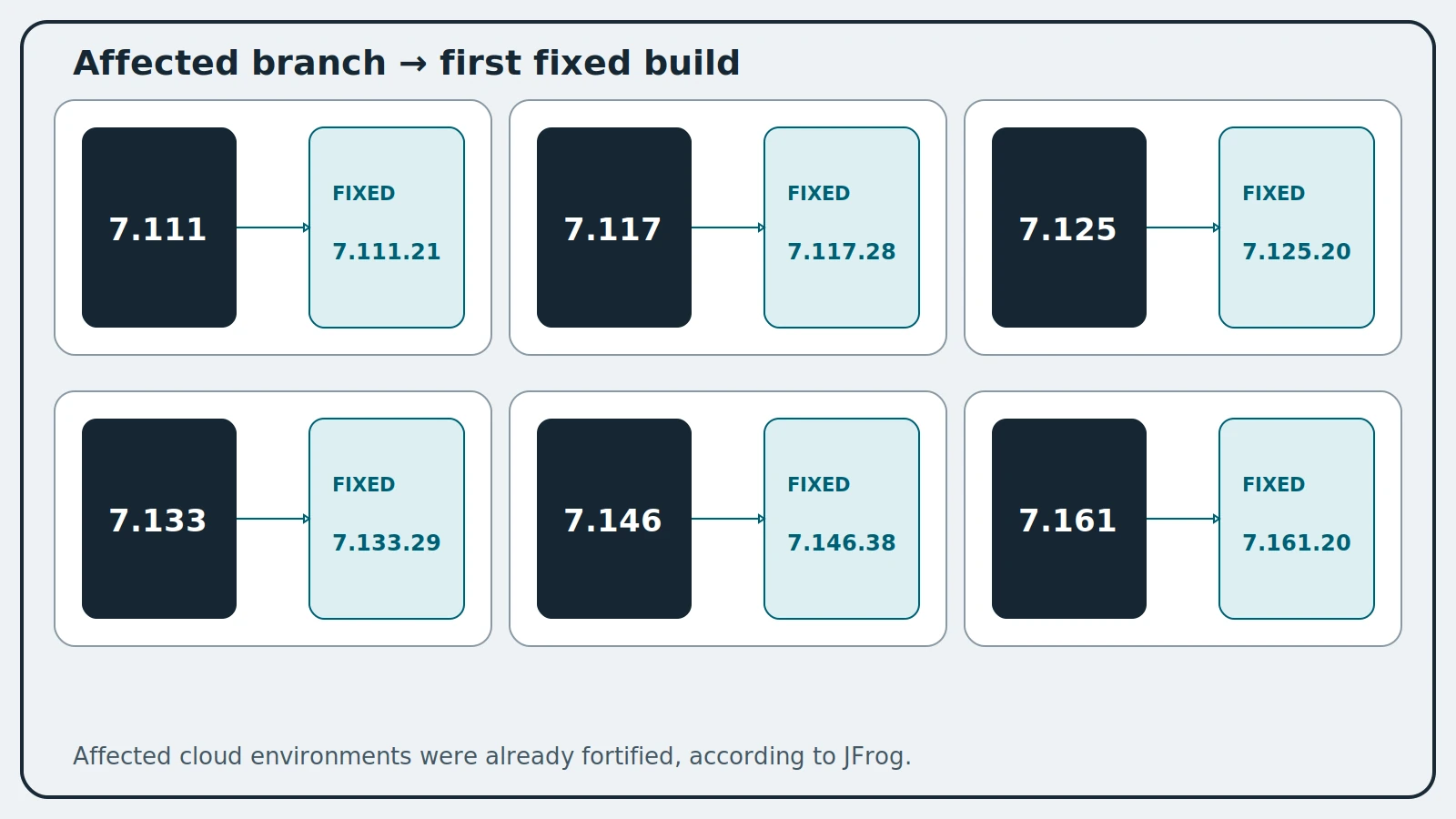
Figure details
Six cards map affected self-hosted Artifactory release branches to JFrog's fixed-version floors. Branch 7.111 is fixed at 7.111.21; 7.117 at 7.117.28; 7.125 at 7.125.20; 7.133 at 7.133.29; 7.146 at 7.146.38; and 7.161 at 7.161.20. JFrog says affected cloud environments were already fortified. The matrix is a version comparison, not a claim that every older unsupported release remains covered by vendor support.
Six branches need upgrades
JFrog lists fixed self-hosted builds for six release branches:
- 7.111.21
- 7.117.28
- 7.125.20
- 7.133.29
- 7.146.38
- 7.161.20
The branch matters. A deployment on 7.146.36 does not become safe because 7.146 is a recent line; it needs 7.146.38 or later. The same comparison applies to the other maintained lines. Operators on an older or unsupported release should follow JFrog’s current support guidance instead of assuming the oldest listed floor extends support backward.
JFrog says affected cloud environments have already been fortified and require no customer action. The upgrade requirement applies to self-hosted environments. The advisory offers no workaround that JFrog presents as equivalent to a fixed build.
Detection starts with uncertainty
No reliable CVE-specific recognition rule is public. JFrog provides no endpoint, HTTP signature, token value, log event, IP address, hostname, filename, or hash tied specifically to exploitation. A generic administrator-token creation event may deserve investigation, but it cannot by itself prove that CVE-2026-82329 was used.
Preserving historical evidence before routine cleanup or upgrade work is therefore important. Investigators need the records their deployment already retains for administrator identities, access-token creation, permission changes, remote-repository configuration, artifact deployment, deletion, promotion, and downloads. Those records should be correlated with normal change windows and known administrator activity.
The investigation can proceed while exploit attribution remains uncertain. Did a new privileged identity or token appear without an approved change? Did repository permissions, upstream definitions, or federation settings change afterward? Did any artifact arrive, move, or leave through that identity? Did build or deployment systems consume those artifacts? Each answer narrows consequence without pretending to identify the exploit request.
If suspicious administrative access is found, version upgrade is only the first containment step. Affected teams must determine which repository credentials, signing material, service tokens, and downstream deployment identities were reachable through the compromised account, then replace the exposed authorities at their issuing systems. Artifact integrity checks should compare promoted or downloaded objects with trusted build records from before the suspicious access window.
Verify the fixed boundary
Inventory every self-hosted Artifactory node and record its running build, network reachability, cluster membership, and upgrade completion. Compare each node with the fixed floor for its branch, restart the service where the upgrade requires it, and capture the post-restart version from the running instance rather than relying on a change ticket or package declaration.
Review administrator identities, tokens, repository permissions, configuration changes, and artifact operations from the earliest plausible exposure through the verified upgrade. Where the available retention cannot reconstruct those events, record that gap as unresolved evidence and prioritize the identities and repositories with the greatest downstream authority.
The production verification test is direct: every self-hosted node reports 7.111.21, 7.117.28, 7.125.20, 7.133.29, 7.146.38, 7.161.20, or a later supported build on its branch. The expected result is no vulnerable node serving traffic and no unexplained administrator token or repository change in the review window.
An artifact repository is a decision point in the software supply chain. Restoring confidence requires proving both halves of that boundary: the vulnerable build is gone, and the artifacts and identities that passed through the service still match trusted records.