
N-able released a fourth N-central hotfix in five weeks after learning of a new vulnerability that lets an unauthenticated attacker run code on the remote-management server. On-premises operators need N-central 2026.3 HF4, build 2026.3.1.14; every earlier build remains exposed, including Hotfix 3, which had arrived only hours before.
The September 6 fix addresses CVE-2026-86218, a static code-injection flaw that N-able scored 10.0 under CVSS 4.0. The urgency is clear, but the exploitation record is not. N-able’s public status post says the company has no confirmation of exploitation in production. Its separate incident communication, reproduced by Huntress, says the unrelated new flaw “has been exploited in the wild.”
Hotfix 3 lasted hours
N-able published Hotfix 3, build 2026.3.1.13, on September 5 for CVE-2026-86206 and CVE-2026-86207. Those flaws could bypass access controls and authentication around internal APIs. A third researcher then reported CVE-2026-86218, leading N-able to publish Hotfix 4 early on September 6.
The Hotfix 4 release notes call it a “critical zero-day vulnerability” and identify 2026.3.1.14 as the fixed build. N-able provides direct upgrade paths from 2025.4, 2026.1, 2026.2, 2026.3, and Hotfixes 1 through 3. The N-central agents installed on managed endpoints do not need an update for this CVE.
Hosted N-central, or NCOD, follows a different path. N-able says it has already patched those instances, so hosted customers have no appliance upgrade to perform. The exposed population is on-premises N-central servers below 2026.3.1.14.
The vendor has not disclosed the vulnerable request, reachable component, exploit chain, or configuration dependency. Defenders therefore cannot infer exposure from a feature setting or search for a signature specific to CVE-2026-86218. Version and deployment type are the reliable scoping facts available now.
Exploitation records conflict
N-able’s status post and release notes say: “At this time, we have no confirmations that this vulnerability has been exploited in production environments.” Huntress preserved a different N-able message saying a third researcher had reported a new, unrelated vulnerability “that has been exploited in the wild.” Neither statement identifies an actor, victim count, time window, or observing party.
Huntress’s incident analysis cannot resolve the conflict. The managed detection vendor began investigating after one customer’s fully patched N-central production appliance was compromised on September 4. It reproduced an authentication-bypass chain against the then-current build 2026.3.1.10, but the appliance’s historical logs had already rotated. Huntress could not determine whether the attacker used CVE-2026-86206, CVE-2026-86207, CVE-2026-86218, or another path.
That limitation matters because it separates a verified compromise from attribution to the newest CVE. Treat N-able’s exploitation claim as an urgent warning and preserve the contradictory no-confirmation statement. The sources do not quantify N-central’s installed base, internet exposure for CVE-2026-86218, or the number of organizations affected by this specific flaw.
One server reaches fleets
N-central is a remote monitoring and management control plane used by managed service providers to administer customer systems. An attacker who gains administrative control can launch scripts and jobs, open remote-control sessions, change accounts or policies, and reach downstream servers and workstations through an already trusted management channel.
That blast radius has been observed around earlier N-central flaws. In August, attackers used N-central’s Take Control feature to move rapidly among customer endpoints and establish Cloudflare tunnels after access through the RMM server was cut off. The new CVE provides pre-authentication code execution on the server, but available evidence does not tie those August behaviors to this flaw.
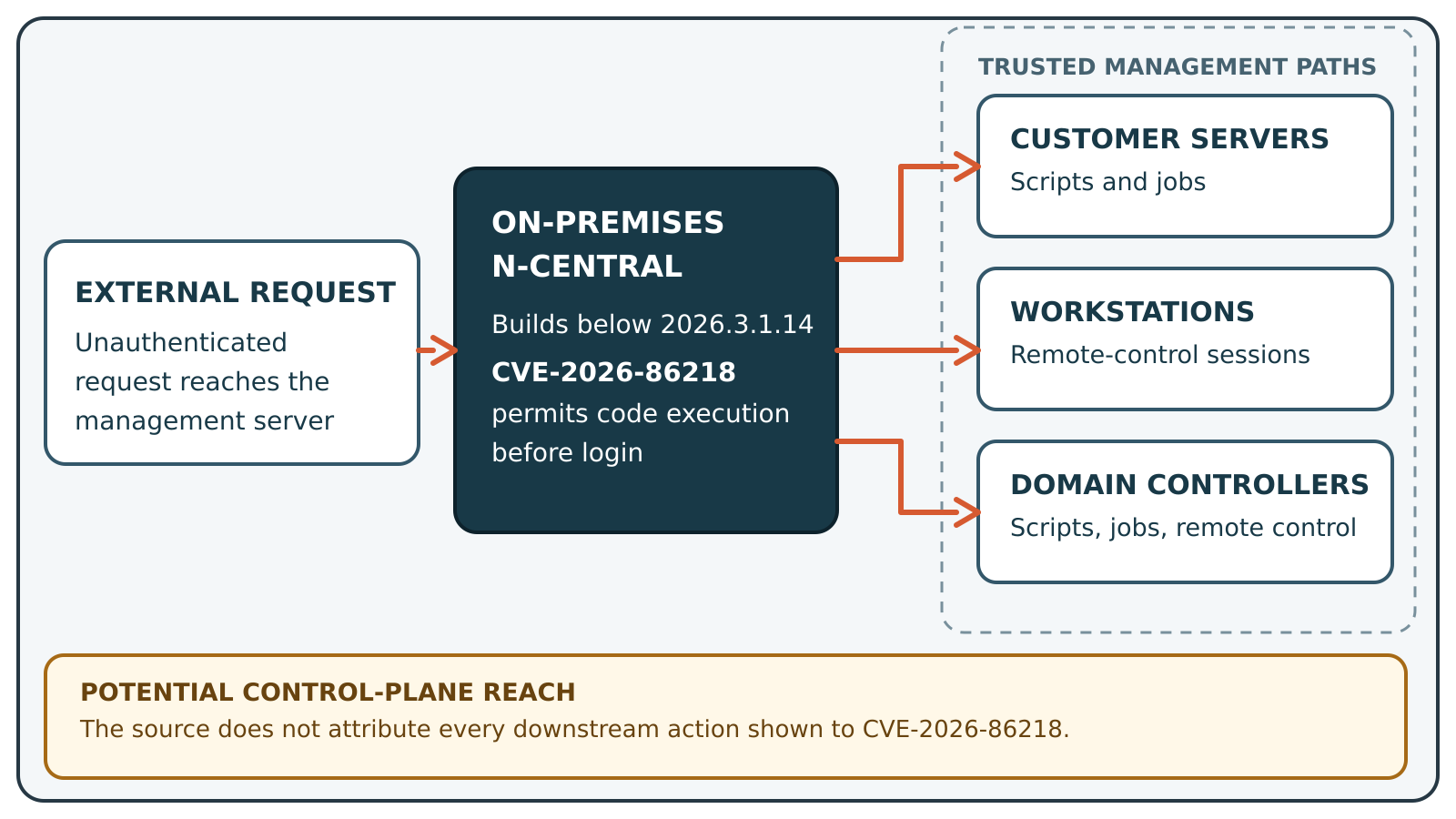
Figure details
An external unauthenticated request reaches an on-premises N-central server running a build below 2026.3.1.14. CVE-2026-86218 permits code execution on that server before login. N-central's trusted management relationships then create separate paths to customer servers, workstations, and domain controllers through scripts, jobs, and remote-control sessions. The figure shows potential control-plane reach described in the primary record; it does not claim that every downstream action was observed through this CVE.
The control plane creates a recovery problem as well as an entry point. A clean build number closes the published flaw, but it does not attest to what happened before the upgrade. Account changes, scheduled jobs, remote sessions, scripts, and endpoint persistence can outlive the vulnerable server state.
Hunt the surrounding activity
Huntress’s newest September pivots are appliance-focused. Review envoy_proxy_HTTPS.log and syslog ncentraldms for successful requests to internal API routes containing encoded values such as %2F. Search user and permission records for new administrative accounts, unexpected role changes, lookalike identities, and addresses carrying the .invalid suffix. The reconnaissance Huntress observed used /remoteControlAction.do?method=getPierDetails with specific appliance IDs.
The longer incident record adds context for remote-control abuse. Correlate ui_access_control.log or its local equivalent with support identities such as [email protected], high-value target systems, unusual hours, and work that has no matching ticket. On managed Windows endpoints, inspect C:\ProgramData\GetSupportService_N-Central\Logs\, including BASupSrvc_*.log.gz and BASupTSHelper_*. Windows Application event IDs 4102, 8192, and 8193 appeared around Take Control sessions in one compromised organization. These files and events also occur during legitimate support work, so presence alone is an investigative pivot.
N-able also told customers reviewing the August incidents to seek a file named svchost.exe in users’ Documents folders and a registered service named Cloudflared. Huntress had not observed either marker in its own telemetry when it published that update.
The surrounding incident infrastructure includes four VPN exit addresses that Huntress says are shared Mullvad or NordVPN services: 173.249.252.200, 87.249.138.34, 37.19.210.32, and 68.235.46.214. Two more intrusion addresses, 23.234.100.105 and 23.234.97.68, were identified as Tzulo VPN exits. Keep those addresses in context; activity from a shared VPN address is not proof of compromise.
N-able’s other August address list contains 37[.]153[.]90[.]88, 92[.]118[.]112[.]181, 173[.]249[.]252[.]176, 185[.]156[.]46[.]150, 23[.]234[.]94[.]43, and 68[.]235[.]46[.]235. Huntress also published mousears[.]synology[.]me, wagoosh[.]direct[.]quickconnect[.]to, who-ripped-one[.]direct[.]quickconnect[.]to, and the malicious Cloudflare tunnel account tag 5568cd69c754b392121f1dbb8f900fda. These values belong to prior N-central incidents and are not signatures for CVE-2026-86218; use them to reconstruct adjacent activity across appliance, firewall, proxy, WAF, and endpoint telemetry.
Verify HF4 and access
Upgrade each on-premises N-central server to 2026.3.1.14. Confirm the build from the appliance after restart, then test console reachability from an untrusted network. The expected result is Hotfix 4 on every on-premises server and no direct console access outside approved office ranges or an administrative VPN.
Patch state is the first half of the check. Preserve the current appliance logs before retention removes more history, then reconcile users, roles, jobs, scripts, remote-control sessions, and security settings against known administrator actions and tickets. Extend the review to domain controllers and other high-value endpoints touched through N-central. An unexplained change or session should trigger incident handling even when the server now reports the fixed build.
If immediate upgrading is impossible, Huntress advises strict IP allowlisting or a mandatory VPN and says a still-publicly-reachable server may need to be taken offline until Hotfix 4 is installed. That choice trades central visibility and remote access for a smaller attack surface; the MSP has to make it with its downstream customer obligations in view.
N-able’s fourth hotfix closes the published server flaw. The harder task is proving that the management plane, its trusted accounts, and the systems behind it still reflect authorized work.