Resecurity reports that INC ransomware has emerged as the dominant actor weaponizing the SonicWall SMA 1000 vulnerability chain. Operators of SMA 6210, 7210, 8200v, and Central Management Server deployments need to apply the hotfix and investigate activity from before the update.
SonicWall has confirmed that two SMA 1000 flaws, CVE-2026-15409 and CVE-2026-15410, were actively exploited. The vendor does not attribute that exploitation to INC in its notice, and a ransomware-group label should not replace evidence from an individual environment. What the new reporting changes is the urgency of that evidence review. Handle a vulnerable remote-access gateway as a possible intrusion point.
Request Forgery and Administrative Code Execution
CVE-2026-15409 is an unauthenticated server-side request forgery flaw in the SMA 1000 Workplace interface. It can make the appliance send requests to unintended locations. CISA’s assessment marks the flaw as automatable, actively exploited, and capable of total technical impact.
CVE-2026-15410 is a separate code-injection flaw in the Appliance Management Console. It requires an authenticated administrator under the vendor’s description, but can then execute operating-system commands. The defensive concern is the sequence: a flaw that reaches internal appliance services can create the conditions for an administrative execution path. The public vendor records confirm both affected components and active exploitation; they do not establish that every observed attack used one fixed chain.
The affected builds are 12.4.3-03245, 12.4.3-03387, 12.4.3-03434, 12.5.0-02283, 12.5.0-02624, and 12.5.0-02800. SonicWall’s fixed floors are 12.4.3-03453 and 12.5.0-02835. The scope covers physical SMA 6210 and 7210 appliances, the SMA 8200v virtual appliance, and CMS across supported hypervisors.
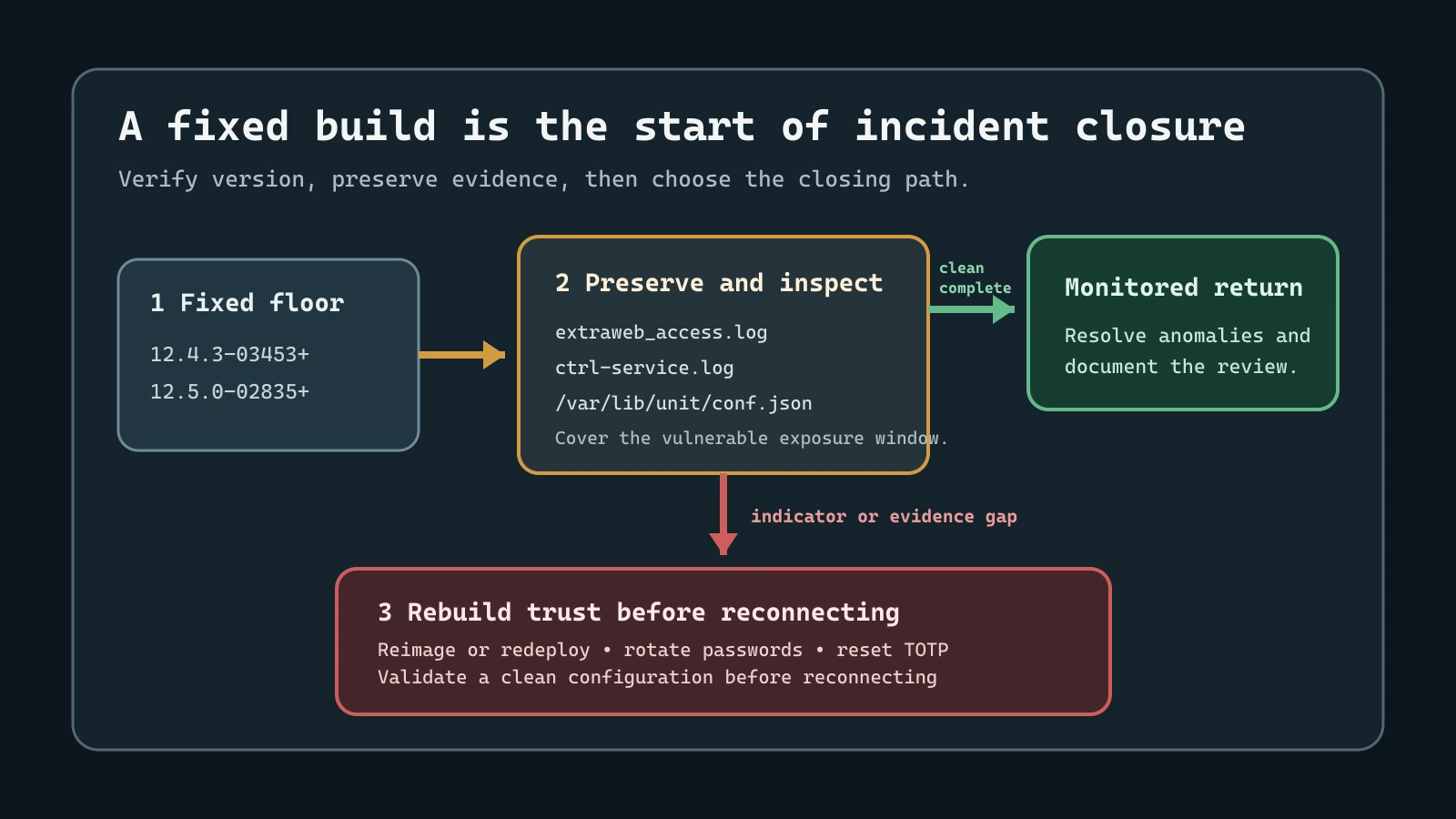
Figure details
The response begins with inventory and fixed-version verification. Defenders then preserve and inspect extraweb_access.log, ctrl-service.log, and /var/lib/unit/conf.json. If no indicators or unexplained changes remain, the appliance can return to monitored service. If an indicator is present, the path moves to reimaging hardware or redeploying virtual appliances, changing user and administrator passwords, resetting TOTP tokens, and validating the clean configuration before reconnecting.
Four Artifacts Guide the Compromise Review
SonicWall names concrete indicators. In extraweb_access.log, look for HTTP 200 responses to /__api__/login or /__api__/logout. In the same log, investigate /wsproxy requests with suspicious host parameters that returned HTTP 101. In ctrl-service.log, search for hotfix removal entries containing a path-traversal name. Inspect /var/lib/unit/conf.json for added routes to the two __api__ paths.
These are triage leads, not a universal proof of compromise. A match needs its timestamp, source, surrounding requests, and configuration history. An absence also has conditions: log retention must cover the appliance’s vulnerable and internet-exposed period, collection must have worked, and the configuration file must not have been replaced before preservation. If those conditions fail, “no indicator found” is weaker than “not compromised.”
Check the configuration history before selecting a backup to restore. The vendor says a backup should be used only if it predates the December hotfix builds 12.4.3-03245 and 12.5.0-02283. If no earlier backup exists, it recommends closely auditing the configuration for tampering. Restoring a newer backup can restore an attacker’s route or other persistence along with legitimate settings.
Patching and recovery answer different questions
The fixed build answers whether the two disclosed flaws remain exposed. Incident response answers whether an attacker already crossed the appliance. SonicWall directs organizations that find indicators to reimage hardware or redeploy virtual appliances, change user and administrator passwords, and reset TOTP tokens. That sequence assumes credentials and appliance state may no longer be trustworthy.
The INC attribution is useful for prioritization, but it should remain attributed. SonicWall and CISA confirm exploitation of the CVEs; the vendor notice does not name the actor. Defenders should avoid turning an ecosystem-level assessment into a claim that every compromised SMA 1000 device led to ransomware, or that every INC intrusion began with these flaws.
Verify Appliances and Secure Affected Accounts
Inventory every physical, virtual, and CMS instance, record its exposure window, and verify it runs at least 12.4.3-03453 or 12.5.0-02835. Preserve the named logs and conf.json before rebuilding or rotating away useful evidence. Search the exact paths and response codes, then review matching events with adjacent requests, source infrastructure, authentication activity, and configuration changes.
If an indicator is present, or if missing retention prevents a defensible review, escalate to incident response. Reimage or redeploy as appropriate, restore only from a qualifying clean backup, rotate user and administrator passwords, reset TOTP tokens, terminate active sessions, and hunt downstream for use of appliance-linked identities.
Resolve the incident after every in-scope instance is on a fixed build, the vulnerable exposure period is covered by preserved evidence or explicitly documented as an uncertainty, the published indicators and unexplained configuration changes are resolved, appliance-linked credentials are trusted again, and rebuilt systems report the intended configuration. A successful hotfix installation is one checkpoint; it is not the decision itself.