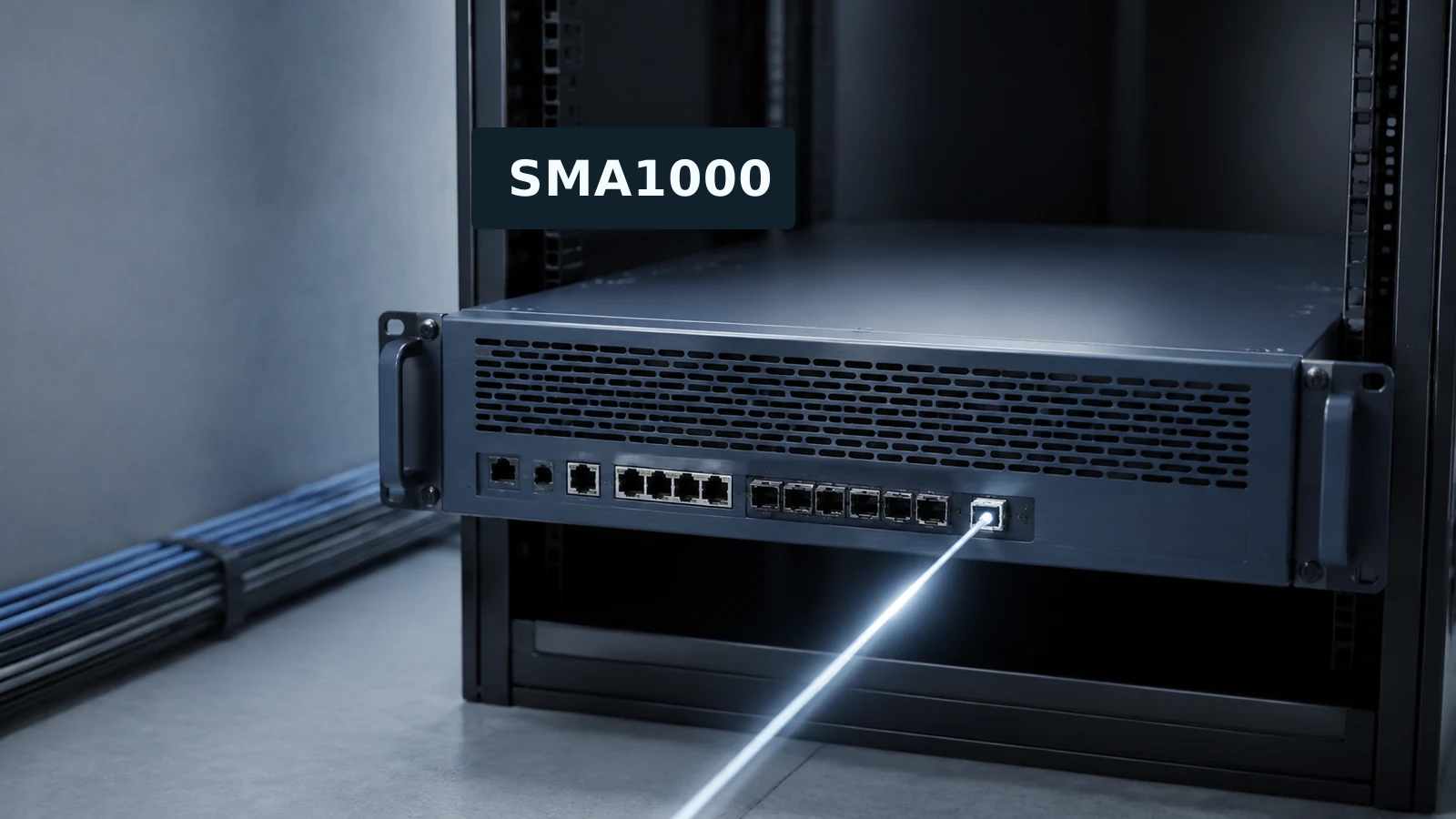
Attackers are exploiting two newly disclosed flaws in SonicWall SMA1000 secure remote-access appliances. One reaches sensitive appliance functions without authentication. The other lets an authenticated administrator execute operating-system commands, turning privileged access into control of the appliance.
The SonicWall product notice is unambiguous: “These vulnerabilities have been confirmed as being actively exploited in the wild.” It tells every organization running an affected physical or virtual appliance to install a fixed hotfix and ask SonicWall support to review the system for indicators of compromise.
CISA added both flaws to its Known Exploited Vulnerabilities catalog on September 2. The agency set a September 5 remediation deadline and requires forensic triage under BOD 26-04 for covered federal systems. CISA lists ransomware use as unknown.
SonicWall and CISA do not identify an attacker, victim, campaign, exploit sequence or incident count. BleepingComputer describes a zero-day chain, while SecurityWeek says exploitation of both flaws suggests a chain. The primary records confirm exploitation of both vulnerabilities without stating that attackers chained them or that every observed intrusion reached command execution.
Two flaws cross different boundaries
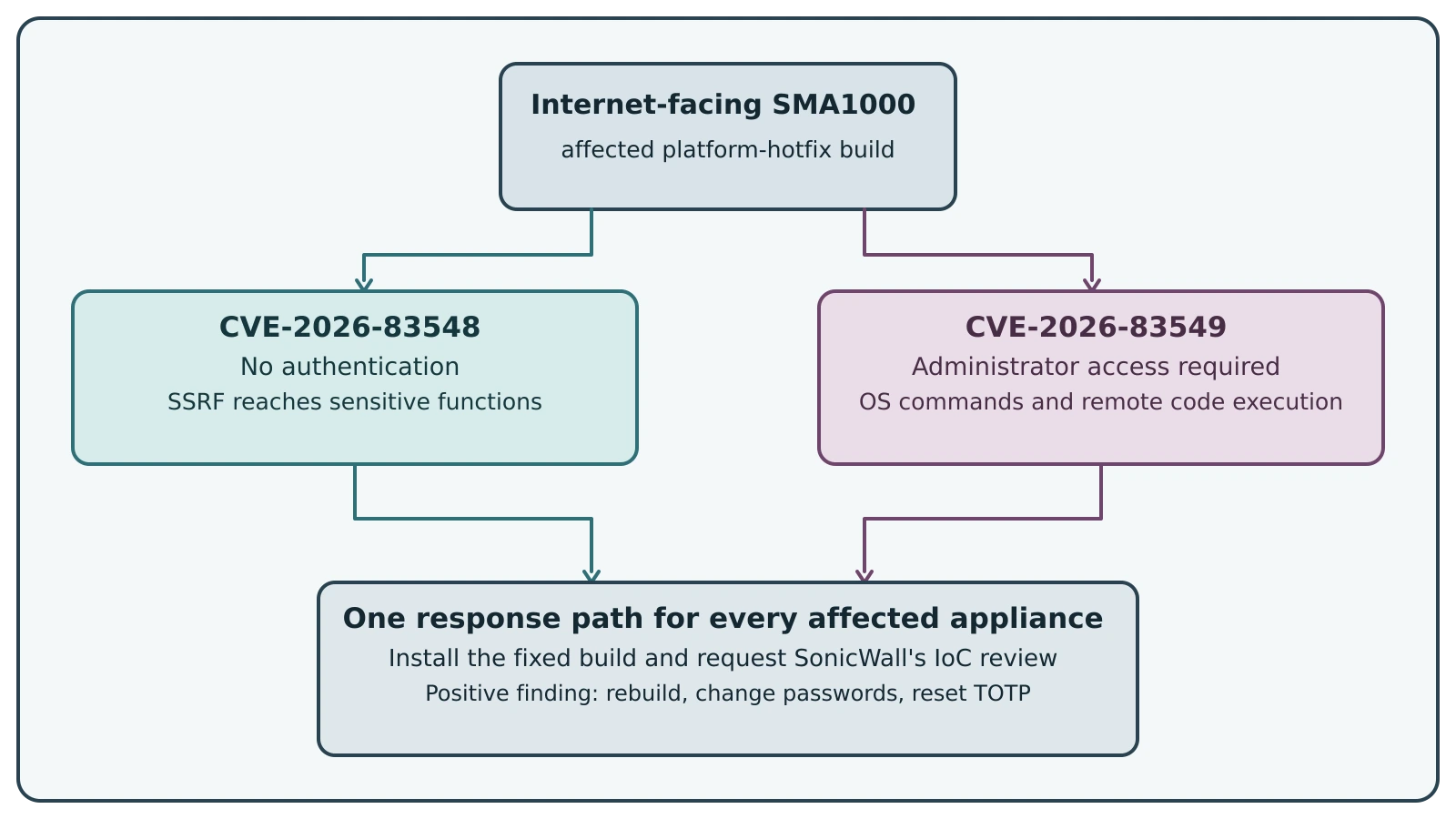
CVE-2026-83548 is a pre-authentication server-side request forgery flaw caused by unintended forward-proxy behavior. SonicWall rates it critical at CVSS 10.0. A remote attacker can reach sensitive functionality and perform unauthorized operations without first signing in.
CVE-2026-83549 is an operating-system command injection flaw. SonicWall rates it high at CVSS 7.8. This path requires an authenticated administrator, then allows arbitrary OS commands and remote code execution. The prerequisite matters for investigation: a successful command-injection attempt implies that the actor already possessed, created or otherwise obtained administrative access.
The sources describe separate access requirements. They do not say the unauthenticated SSRF creates the administrator session required for command injection. Treat the two flaws as concurrent exposures until appliance evidence or SonicWall support establishes the route used in a specific incident.
Long description
The diagram splits below an internet-facing SMA1000 appliance. The left path shows CVE-2026-83548 reaching sensitive appliance functionality without authentication through unintended forward-proxy behavior. The right path shows CVE-2026-83549 beginning with authenticated administrator access and ending in arbitrary operating-system commands. The paths converge on the defender response: identify the deployed platform-hotfix build, install the fixed build, and obtain a SonicWall support review for indicators of compromise. A positive review leads to re-imaging or redeployment, password changes, and TOTP-token resets. The article explains that the public record does not establish a chain between the two flaws.
Affected builds define the exposure
The notice covers SMA 1000 models 6210 and 7210 plus the virtual 8200v on every supported hypervisor. Deployments on the 12.4.3-03453 platform-hotfix line are affected across all versions of that build line. The same is true for the 12.5.0-02835 line.
The first fixed platform-hotfix builds are 12.4.3-03526 and 12.5.0-02952. Inventory must use the complete platform-hotfix identifier. A record that says only 12.4.3 or 12.5.0 cannot distinguish an affected appliance from a fixed one.
This scope includes both physical and virtual appliances. An asset search should cover hardware inventories, hypervisor management, cloud accounts, disaster-recovery instances and powered-off templates that might later return to service. Record each appliance’s model, deployment type, management owner, internet exposure and complete platform-hotfix build.
Neither source quantifies how many appliances are exposed or compromised. The defensible scale is limited to three named models, two affected build lines and confirmed exploitation of both CVEs.
Recognition requires a support review
SonicWall has not published the indicators used to identify compromise. The notice instead directs customers to contact technical support for an IoC review. That makes support engagement part of the incident workflow, rather than an optional escalation after local tools find something suspicious.
Preserve evidence before upgrading or rebuilding. Capture the complete build identifier, appliance configuration, administrative-account records, authentication events, remote-access activity and available system logs according to the organization’s evidence-handling process. Retain the time range from the appliance’s earliest exposure on an affected build through the support review and remediation.
The public sources provide no self-service query, signature or expected clean result. They also do not state which logs survive a hotfix or re-image. Ask SonicWall support to document the evidence reviewed, the time coverage, the finding and any visibility gaps. A finding of no known indicators is bounded by that evidence and window; it is not proof that exploitation never occurred.
The evidence that would change this recognition state is a SonicWall publication of indicators, log locations, audit operations or a supported verification procedure. Until then, invented generic detections would create false confidence and could misclassify ordinary appliance behavior.
Hotfix and recover appliance trust
Upgrade every affected deployment to 12.4.3-03526, 12.5.0-02952 or a later fixed platform-hotfix in its supported branch. Confirm the running build after the appliance returns to service, and reconcile the inventory so powered-off or standby systems cannot reintroduce an affected image.
Arrange the support-assisted IoC review for every appliance that ran an affected build. If indicators are detected, SonicWall directs customers to re-image physical appliances or redeploy virtual ones. The vendor also calls for changing all user and administrator passwords and resetting TOTP tokens. Those steps recognize that an attacker controlling a remote-access gateway may have reached identities and authentication material beyond the vulnerable code.
Sequence recovery so the rebuilt appliance and replacement credentials become authoritative together. Revoke old sessions where the product and connected identity systems allow it, validate administrative access through the intended management path, and review downstream identity records for use of retired credentials after the reset time.
Verification remains a documented support outcome plus production state. The expected operational result is that every in-scope appliance reports a fixed complete platform-hotfix build, every affected system has a recorded support-review disposition, and any positive finding maps to a rebuilt appliance and completed password and TOTP resets. Record any period the available evidence could not cover as unresolved exposure.