
On August 26, 2026, the U.S. Cybersecurity and Infrastructure Security Agency added a seven-year-old Microsoft SQL Server flaw to its Known Exploited Vulnerabilities catalog. CVE-2019-1068 now carries confirmed exploitation, an August 29 federal remediation deadline, and a requirement for forensic triage under Binding Operational Directive 26-04.
That new exploitation finding is the reason to revisit a bug Microsoft fixed in July 2019. The public sources do not identify an actor, campaign, exploit query, victim, or indicator. They do establish that a low-privilege network attacker can submit a crafted query and run code as the SQL Server Database Engine service account.
The exploit runs as SQL Server
Microsoft’s advisory says SQL Server incorrectly handles the processing of internal functions. Exploitation requires an authenticated attacker to submit a specially crafted query to an affected server. The update changes how the Database Engine processes those functions.
The distinction between authentication and authorization is important here. This is not documented as a connectionless, pre-authentication server takeover. NVD’s recorded CVSS vector requires low privileges, low attack complexity, no user interaction, and network reachability. A database login with limited rights can still reach a flaw whose code executes in the Database Engine service-account context.
That service identity determines the next boundary. An instance running under a tightly scoped virtual or managed service account presents a different downstream risk from one using a privileged local or domain identity. In either case, the documented result is remote code execution inside a database tier that may hold sensitive data, credentials, linked-server relationships, scheduled jobs, and access to adjacent systems.
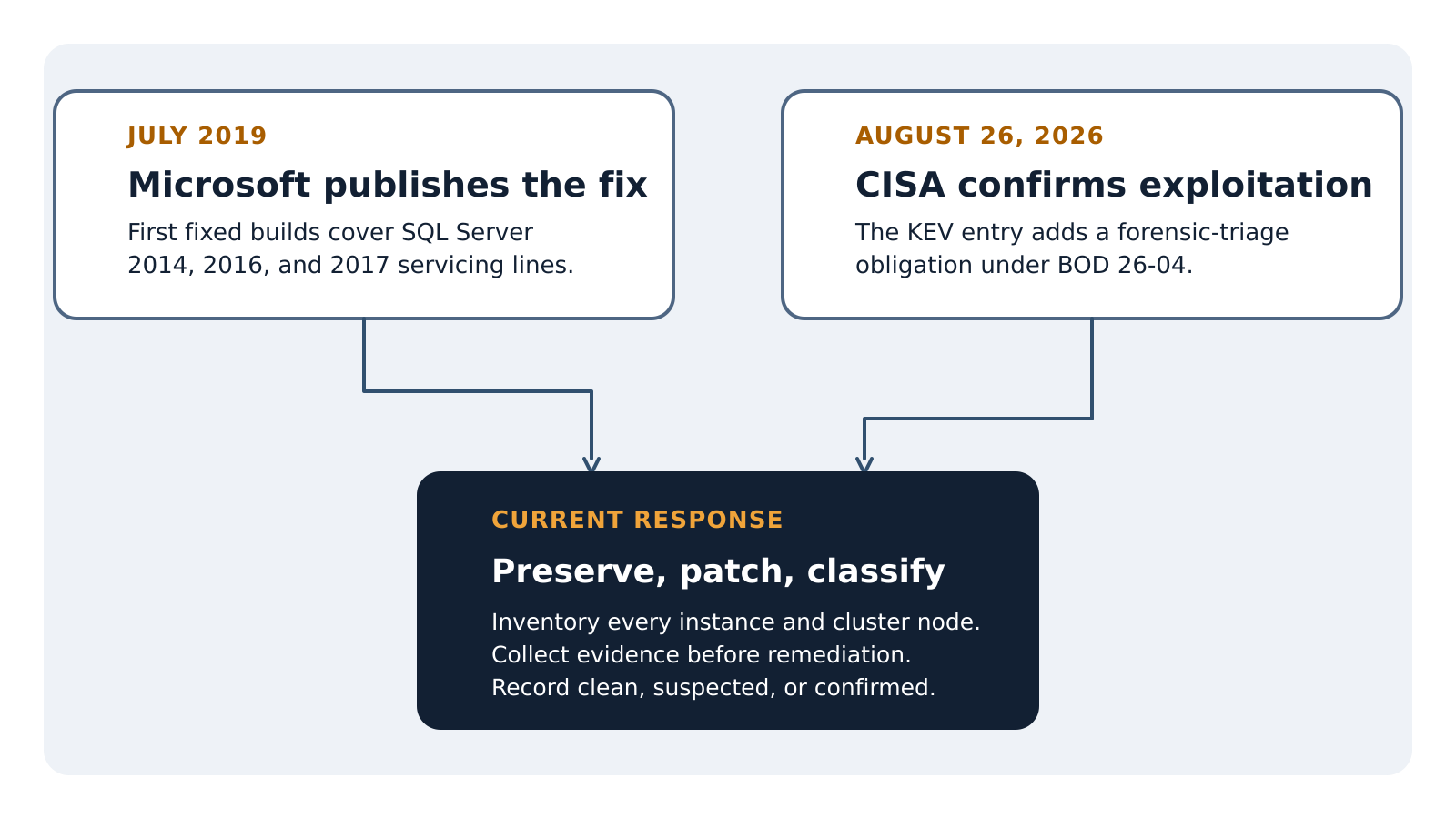
Figure details
The diagram separates two points in time. In July 2019, Microsoft published updates for affected SQL Server 2014, 2016, and 2017 servicing lines. On August 26, 2026, CISA confirmed exploitation of CVE-2019-1068 and required BOD 26-04 forensic triage. The two tracks meet at the current response: inventory every instance and cluster node, preserve volatile and persistent evidence, install the update that matches the existing GDR or CU servicing line, and classify the result as no evidence of compromise, compromise suspected, or compromise confirmed.
CISA does not quantify the exploitation. Its catalog lists ransomware use as unknown, and neither CISA nor Microsoft publishes a CVE-specific process chain, log event, domain, IP address, file hash, or database-audit signature. Detection therefore starts with the evidence each organization already retains rather than a shared indicator list.
Five servicing lines need review
The vulnerable set spans SQL Server 2014 SP2 and SP3, SQL Server 2016 SP1 and SP2, and SQL Server 2017. Each baseline had separate General Distribution Release and Cumulative Update paths. Microsoft warns administrators to identify the installed build before choosing a package: a system maintained on the GDR path needs the GDR update, while a system already on the CU path needs the matching CU update.
| SQL Server baseline | First fixed GDR build | First fixed CU build |
|---|---|---|
| 2014 SP2 | 12.0.5223.6 | 12.0.5659.1 |
| 2014 SP3 | 12.0.6108.1 | 12.0.6293.0 |
| 2016 SP1 | 13.0.4259.0 | 13.0.4604.0 |
| 2016 SP2 | 13.0.5101.9 | 13.0.5366.0 |
| 2017 RTM | 14.0.2027.2 | 14.0.3192.2 |
These are the first fixed builds on the 2019 servicing lines. A later build on the same line includes the correction. A product name alone is weak inventory evidence because the vulnerable and fixed releases share the same major version. Record the output from every instance and every cluster node:
SELECT
  SERVERPROPERTY('ProductVersion') AS product_version,
  SERVERPROPERTY('ProductLevel') AS product_level,
  SERVERPROPERTY('Edition') AS edition;
Microsoft’s update guide also covers SQL Server 2017 on Linux and Linux containers. For clustered instances, it recommends updating the inactive node first, then the active node, and confirming that every component on every node has been updated. An inventory that stops at the listener or primary node can leave a failover target vulnerable.
Triage starts before patching
The federal directive creates a second obligation beyond the version check. CISA’s implementation guidance says agencies must scope affected systems, preserve evidence, stabilize and patch, contain suspected systems, analyze for compromise, and make an escalation decision. The directive is compulsory for Federal Civilian Executive Branch agencies. Other organizations can use the sequence as a defensible response model for the same exploitation finding.
CISA’s central warning is direct: “Do not alter or remediate systems prior to evidence/artifact collection when possible.” Patching, restarting, or failing over an instance can erase memory, temporary files, live connections, and process ancestry that would help determine whether the server was used before the update.
Start with the asset record: instance name, host, cluster role, container image or virtual machine, network exposure, current build, servicing line, Database Engine service identity, and every application or user principal allowed to connect. Preserve volatile data and the persistent records that already exist around that system. Those may include SQL Server error logs, SQL Server Audit or Extended Events data, SQL Agent job history, Windows logs, endpoint process telemetry, network-flow records, and authentication records. These are evidence sources, not published CVE-2019-1068 indicators.
After collection, install the package that matches the branch and servicing model. Isolate a system when the preserved evidence shows unauthorized access, threat-actor presence, lateral movement, persistence, data staging, or exfiltration. CISA asks responders to classify the result as no evidence of compromise, compromise suspected, or compromise confirmed, and to document the supporting evidence rather than infer the answer from patch status.
Prove the host stayed clean
Run the version query against every SQL Server instance and cluster node, then compare each build with the correct row and servicing line. Confirm that vulnerability scanning no longer identifies CVE-2019-1068. Also verify that the Database Engine service uses the intended least-privilege identity and that retired nodes, images, or disaster-recovery copies cannot return an older build to service.
The incident check is separate. Reconcile connections, queries, process launches, account changes, jobs, persistence, outbound traffic, and data movement across the retained exposure window. The sources do not disclose an exploit signature, so record the telemetry covered, its retention limits, and every gap. The expected result is a fixed build on every reachable instance plus a triage report that supports one CISA outcome with preserved evidence.
A green version check resolves current exposure. It does not resolve history. For CVE-2019-1068, the patch is seven years old and the exploitation evidence is new; organizations need build proof for every instance and a documented account of what the server did before that proof existed.