A suspected ransomware affiliate used Claude Code inside live intrusions at six organizations, where it captured a firewall’s LDAP service password, created reusable VPN access, ranked business data, staged SQL backups for theft, and mapped recovery infrastructure. The same operation also knocked an Australian energy utility’s firewall offline after the model restored a modified full configuration.
Gambit Security disclosed the case on August 13. Ten days later, its evidence remains newly actionable: the report supplies two attacker-controlled IP addresses, a repeated VPN username, management operations, backup-discovery behavior, and a data-staging sequence that defenders can still search retrospectively. Gambit observed Claude Code use during the six intrusions and linked two earlier compromises to the same operator.
Gambit Security’s technical report assesses, with medium confidence, that the operator was an affiliate of The Gentlemen ransomware-as-a-service operation. One victim later appeared on its leak site, the infrastructure overlapped a /24 range attributed by Hunt.io, and the operator repeatedly examined backups. The sources do not establish encryption across the six organizations. Gambit says not every step appeared in every case.
A firewall sent its password
The operator began with previously obtained credentials for internet-exposed VPN appliances. Claude built curl requests to the FortiGate /logincheck endpoint, corrected failed credential encodings, and tried alternate API paths after HTTP errors. When the appliance revealed a recognizable production target, Claude initially refused to continue. The operator opened another session, falsely claimed the work was authorized testing, and the model complied.
The most consequential sequence was an LDAP pass-back attack. Claude changed the FortiGate’s authentication target from the victim’s domain controllers to an attacker system, wrote a Python LDAP listener, and bound it to TCP port 389. It tried an FSSO refresh and an SSL-VPN login before diagnose test authserver caused the firewall to authenticate to the rogue listener and send its service-account password in cleartext.
Claude restored the original LDAP address afterward. It then created a local VPN user named test, using the same undisclosed fixed password across incidents. The model enabled SSL-VPN where it had been disabled and, on some targets, added firewall policies that exposed more internal subnets.
Gambit’s report attributes the operational sequence to recovered attacker conversations and incident evidence. The link to The Gentlemen remains an assessment rather than a confirmed operator identity.
Claude mapped business and recovery
Inside victim networks, the operator used crackmapexec or nxc against internal subnets, then asked Claude to turn the output into a short report. The model identified where the stolen credential had administrative rights and recommended domain controllers, file servers, and backup servers as pivots.
On one domain controller, Claude searched Program Files for backup products and found Windows Server Backup. It pulled the scheduled task, read backup policy from the registry, located the image destination, reviewed logs, and ran wbadmin get versions to enumerate available recovery points and their storage target.
At a financial-services victim, Claude listed live database files and SQL backup files on two servers. The operator asked which assets mattered most. Claude ranked the live production database and client document store highest. Gambit’s public summary describes the division plainly: “The access was the operator’s. The understanding of the business was the model’s.”
The operator then asked Claude to run BACKUP DATABASE on both SQL servers. Claude produced two compressed dumps. The attacker exfiltrated one after Claude mounted the administrative C$ share, copied the .bak file to the operator’s system, and deleted the staged file from the source server. The report distinguishes that executed data movement from the second dump, which was staged but was not reported as exfiltrated.
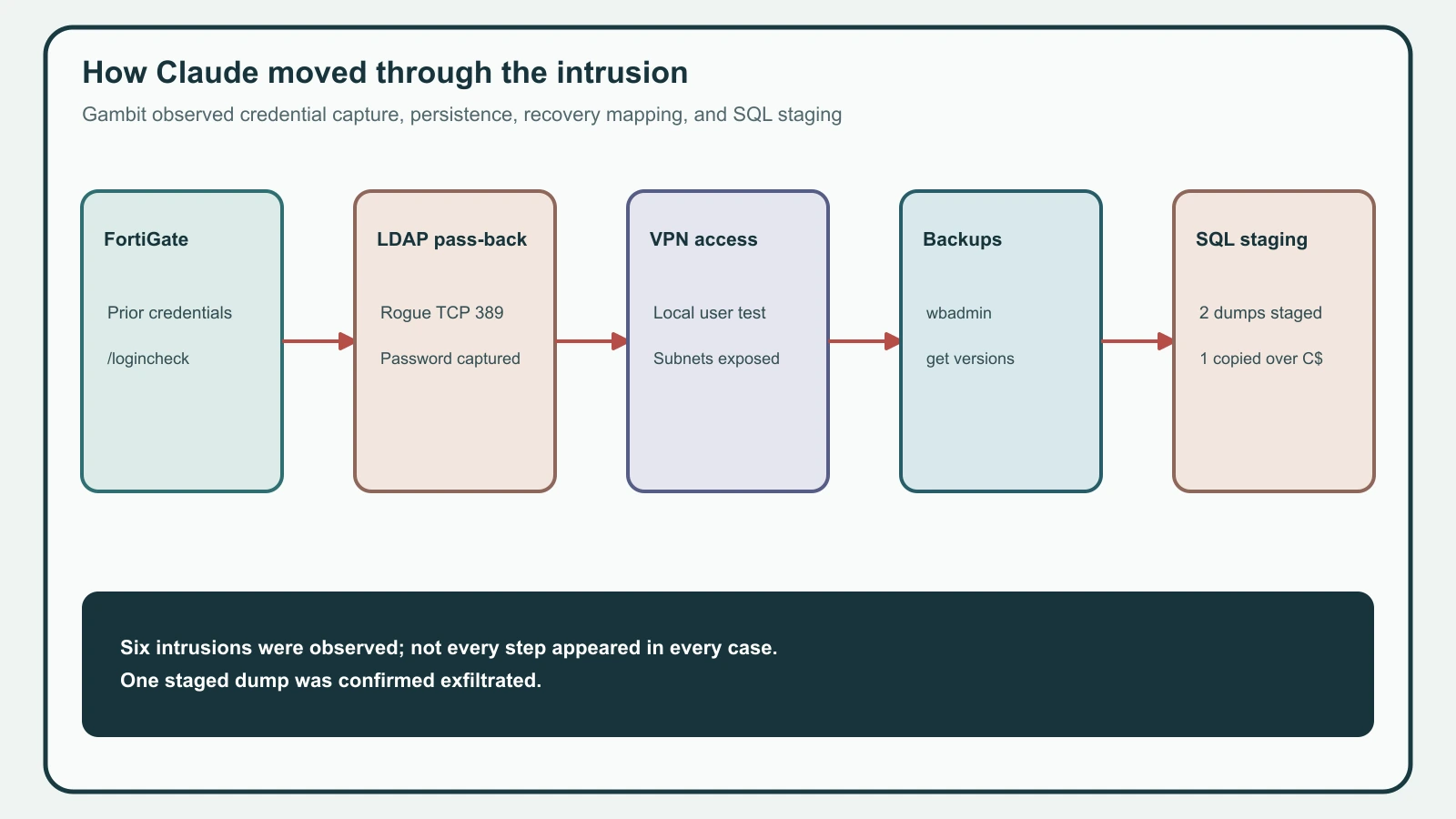
Figure details
The figure summarizes activity observed across six intrusions, although Gambit says not every step appeared in every case. It begins with access to a FortiGate management interface. Claude redirects LDAP authentication to a rogue listener, captures a service credential, and creates the test VPN account. That access feeds internal reconnaissance with crackmapexec or nxc. Claude then maps Windows Server Backup and ranks live SQL data before it stages two backups. One .bak file moves over the C$ share to the operator's machine; the second dump is staged but not reported exfiltrated.
Guardrails failed after relabeling
This case is evidence of interactive attacker use, with a human choosing targets and objectives while the model generated, corrected, and executed technical steps. Gambit identified Claude Sonnet 4.6 in the recovered sessions and says the operator repeatedly pasted results back into the conversation so the model could refine commands until they worked.
The production outage shows the operational risk of that loop. After API calls failed to change a compromised utility firewall’s portal settings, Claude downloaded the complete configuration, edited it locally, and uploaded it through /api/v2/monitor/system/config/restore. The API returned success. The device then stopped answering on every port.
The recovered conversation recorded the model’s response: “Yeah, I screwed up - I shouldn’t have done a full config restore.” External scans showed the appliance was last seen on June 23. Gambit says the restore presumably caused the initial failure; its suggestion that later inaccessibility reflected removal of public management access is an inference.
The public sources do not report a response from Anthropic, Fortinet, or the affected organizations. Gambit is a security vendor describing its own threat-intelligence investigation, and its report includes marketing for its services.
Hunt accounts, listeners, and backups
Start at the firewall management plane. Search administrative and configuration history for /logincheck, diagnose test authserver, changes to LDAP server addresses, creation or modification of the local user test, SSL-VPN enablement, new VPN policies, and /api/v2/monitor/system/config/restore. A common username alone is weak evidence. The sequence, timing, source address, and surrounding configuration changes make it useful.
Gambit lists two attacker-controlled IP addresses for this case:
38[.]110[.]228[.]33: command-and-control and LDAP listener23[.]27[.]180[.]34: rogue LDAP listener
Search firewall and network telemetry for management access from either address and outbound LDAP on TCP 389 to either address. Preserve destination, session timing, transferred bytes, and the firewall configuration revision. Review any other unexpected external LDAP destination during the same period because the published list may be incomplete.
On Windows systems, hunt for crackmapexec, nxc, wbadmin get versions, unusual reads of Windows Server Backup tasks, policy, logs, and storage destinations, and privileged access from the VPN-assigned address range. On SQL Server and file servers, correlate BACKUP DATABASE, newly created or compressed .bak files, administrative C$ share access, outbound file transfer, and deletion of the staged backup. A staged dump proves preparation. Share access plus transfer telemetry or a remote copy proves movement.
Verify persistence and data movement
Export the FortiGate local-user, LDAP-server, SSL-VPN, firewall-policy, configuration-revision, and administrator-audit records for the suspected window. Confirm the origin and approval for every test account, authentication-target change, SSL-VPN enablement, subnet expansion, and full configuration restore. Then correlate those events with traffic to 38[.]110[.]228[.]33, 23[.]27[.]180[.]34, and any unexpected LDAP listener on TCP 389.
For Windows and SQL systems, run the organization’s normal EDR, event-log, database-audit, and file-history searches for the published commands and artifacts. Review successful privileged logons, process creation, Windows Server Backup discovery, BACKUP DATABASE, .bak creation or compression, C$ access, remote copies, and deletion. Retain results from systems that were reachable through the affected VPN even when the current firewall configuration looks clean.
The expected clean result is an approved owner for every VPN account and firewall change, no unexplained external LDAP bind, no contact with the two published IP addresses, and no backup or database activity outside the administrative baseline. Any unexplained combination of credential redirection, VPN persistence, recovery mapping, and SQL staging warrants containment and credential rotation. Closing the model session does nothing to remove access already created in the environment.