API-enabled Progress Kemp LoadMaster appliances now require both immediate remediation and retrospective exposure review. CISA added CVE-2026-8037 to its Known Exploited Vulnerabilities catalog on August 7, confirming exploitation of the command-injection flaw. The Progress LoadMaster security bulletin says organizations running the GA line at 7.2.63.1 or earlier, or the LTSF line at 7.2.54.17 or earlier, are affected when the API is enabled.
The immediate boundary is exact: update GA appliances to 7.2.63.2 or later and LTSF appliances to 7.2.54.18 or later. The incident boundary is harder. CISA says an unauthenticated attacker can execute arbitrary commands on the appliance, so a previously reachable vulnerable API needs retrospective review even after the version check turns green.
Missing terminator reaches the shell
watchTowr’s analysis traces the flaw to escape_quotes(), a function intended to make user input safe inside a single-quoted shell argument. watchTowr credits Syed Ibrahim Ahmed of TrendAI Research with finding the vulnerability. When the input contains a quote, the vulnerable code allocates a heap buffer with malloc(), copies an escaped representation, and fails to append a null terminator.
The missing terminator changes everything.
That omission changes the meaning of the buffer. Code that later treats it as a C string continues reading beyond the intended escaped input until it encounters a zero byte. watchTowr showed that an attacker can shape adjacent heap contents so command text follows the escaped value. LoadMaster then incorporates the resulting string into a command executed through system().
The result is pre-authentication command execution rather than a simple crash. eSentire says the vulnerable path is reachable through /accessv2 when the API is enabled. The attacker still needs network access to that API; no valid LoadMaster credentials are required.
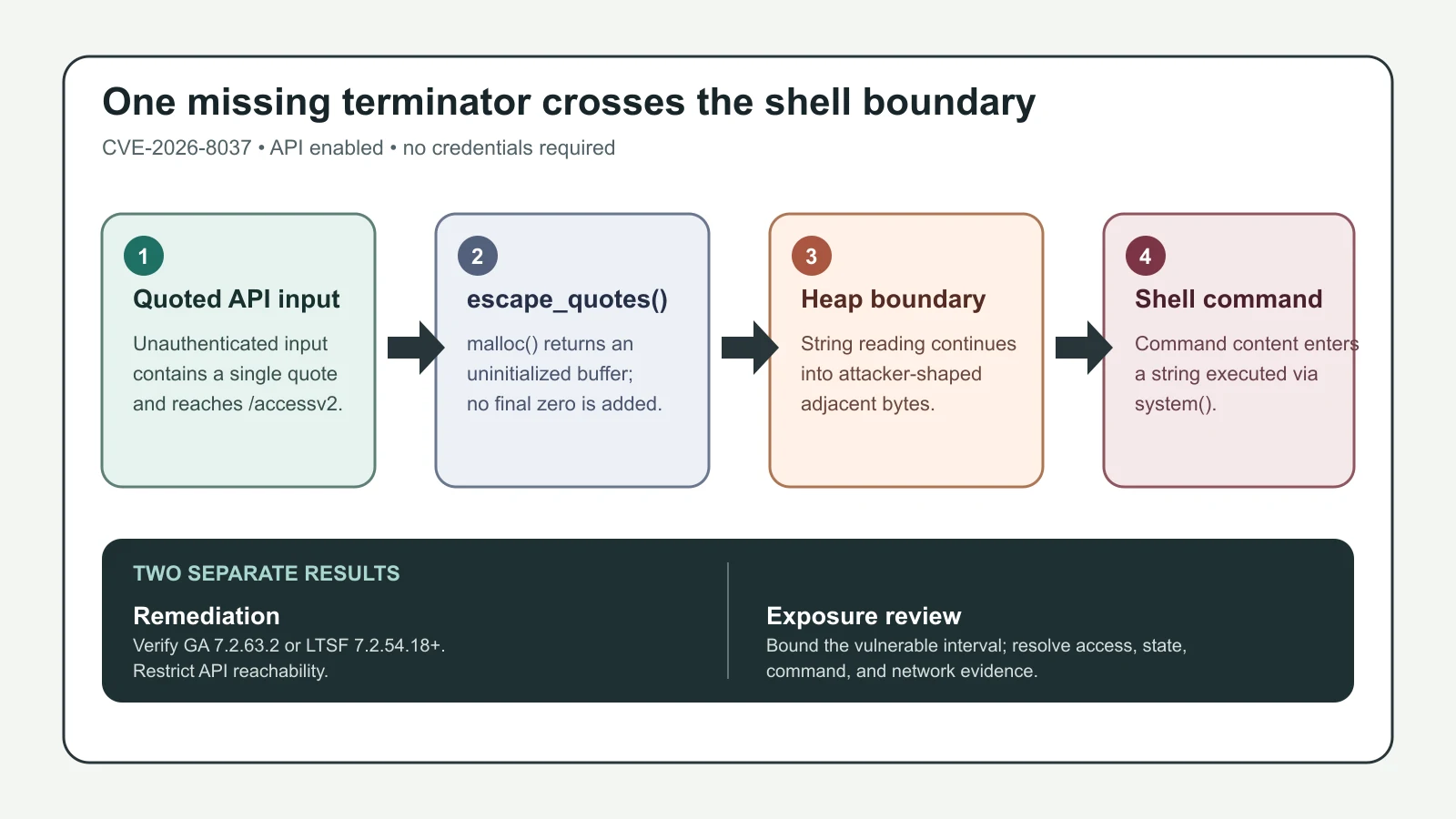
Figure details
An unauthenticated request containing a single quote reaches an enabled LoadMaster API through the accessv2 path. The escape_quotes function allocates a heap buffer but fails to add a terminating zero byte. String processing continues into adjacent attacker-shaped heap data, bringing command content into a shell command executed by the appliance. The fixed versions initialize and terminate the buffer. Defenders must verify both the running release and the earlier API exposure window.
eSentire saw unsuccessful exploit attempts
eSentire’s Threat Response Unit observed attempts beginning June 29, the day functional proof-of-concept code became public. It published three source addresses: 192.42.116[.]58, 192.42.116[.]105, and 146.70.139[.]154.
Progress said on July 31 that it was not aware of exploitation and had received no direct reports of customer impact. CISA’s August 7 KEV entry established that exploitation had occurred. eSentire’s narrower observation covers attempts beginning June 29; the cases it investigated were unsuccessful and produced no observed post-compromise activity.
The eSentire advisory states: “In cases observed by eSentire, exploitation was not successful, and as such, no post-compromise activity was observed.” The observed cases stopped there. CISA’s broader KEV determination confirms exploitation in the wild without naming an actor, publishing a victim count, or describing ransomware use as known. Neither source quantifies successfully compromised appliances.
Use the addresses as initial scoping pivots. Search reverse-proxy, firewall, load-balancer, and API-access records for /accessv2 requests from them, then widen the review to other unfamiliar sources and anomalous request patterns during the full period the vulnerable API was reachable.
Verify release and API exposure
Inventory physical, virtual, cloud, test, disaster-recovery, and standby appliances. Record the release line and running version on each device. A GA appliance passes the CVE boundary at 7.2.63.2 or later; an LTSF appliance passes at 7.2.54.18 or later. Verify the state on the appliance rather than relying on a change ticket, image label, or management inventory.
The running version is the proof.
Record whether the API is enabled and every network path that could reach it. Disable the API where it is not required. Where it is required, restrict access to trusted management networks and explicit administrative sources. That restriction reduces exposure to the vulnerable command path and to future management-plane flaws. The update remains required.
Preserve appliance, network, proxy, and management logs before rotation or rebuild. Review unexpected configuration changes, administrator activity, certificate or key access, new back-end targets, altered routing or WAF state, and outbound connections that do not match normal appliance behavior. Correlate those events with network telemetry for the services behind LoadMaster.
Those broader checks are defensive inferences from command execution on a network-edge appliance. The cited sources limit their CVE-specific indicators to the published addresses and do not provide a complete post-exploitation signature.
If evidence suggests command execution, isolate the management plane while preserving evidence. Replace the appliance from a trusted image and carefully review configuration before restoration. Rotate credentials, API secrets, certificate private keys, and administrative material that the appliance could read, using a clean administrative system. Review their use histories from the earliest plausible access time.
A rebuild alone is insufficient.
A rebuild without state review can restore attacker-created configuration. A patch without retrospective evidence can leave downstream access unexplained. Inspect the internal services the appliance could reach and the traffic it could observe or redirect; account for changes that fall outside approved administration.
Verify the fixed appliance and its history
The verification point is a LoadMaster reporting GA 7.2.63.2, LTSF 7.2.54.18, or a later fixed release. The running version must be verified directly, API need and reachability documented, and unnecessary access removed. These releases supersede GA 7.2.63.1 and LTSF 7.2.54.17.
The same test must account for the vulnerable interval, preserved API and network evidence, the published source addresses, wider anomalous traffic, configuration and administrator changes, and unexpected command or outbound activity. The expected result is a fixed appliance with no unexplained activity in the retained exposure record.
If the earlier exposure window cannot be bounded or the necessary evidence does not exist, record that uncertainty. Rebuild from trusted media. Rotate readable secrets and keys, then review reachable internal services. A fixed version closes CVE-2026-8037; it does not retroactively prove the edge stayed clean.