
Security researchers have turned a patched NetScaler SAML memory flaw into unauthenticated code execution inside the appliance’s root packet engine. The August 14 watchTowr Labs analysis moves the issue beyond the denial-of-service impact in Citrix’s June bulletin and gives exposed remote-access operators a new reason to verify upgrades now.
The attribution needs care. watchTowr believes the flaw is CVE-2026-8452, based on the bulletin’s “memory overflow” description and the relevant binary changes, but says Citrix did not map individual researchers to individual CVEs. Citrix describes CVE-2026-8452 as a memory overflow causing unpredictable behavior and denial of service. That conflict remains unresolved.
A SAML receipt overruns memory
SAML signatures contain a SignedInfo block that identifies what was signed and which canonicalization and signature methods apply. Before checking the signature, NetScaler rewrites that XML into a standard byte representation. The product performs part of that work in nsppe, its packet-processing engine.
watchTowr found that vulnerable builds copy attacker-controlled canonicalized data into a fixed-size global buffer without first proving that it fits. One useful input is InclusiveNamespaces, whose PrefixList attribute accepts a space-separated set of unique namespace prefixes. A remote sender can make that list long enough to push the copy beyond its destination.
“Send an oversized SignedInfo element and the copy continues beyond the end of the buffer,” the researchers wrote. In their debugger, a crafted list corrupted adjacent state and replaced a destination pointer with recognizable attacker-pattern bytes. The first reproducible result was a crash in ns_memcpy_avx inside the root nsppe process.
The patched 13.1 binary adds explicit length checks around the vulnerable copies. That change gave the researchers both the root cause and a boundary for developing the crash into controlled code execution.
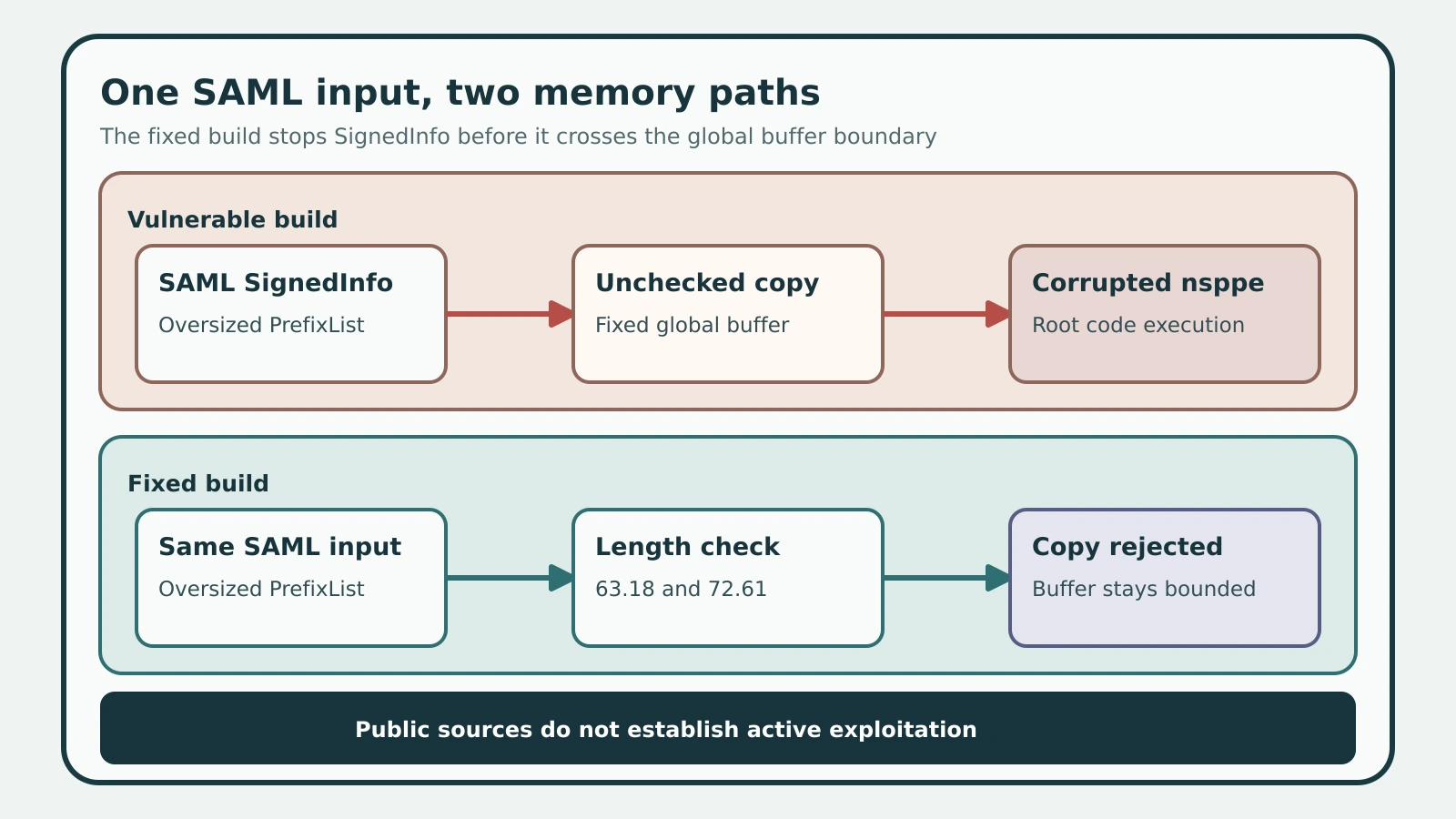
Figure details
The figure begins with an unauthenticated SAML message containing an oversized InclusiveNamespaces PrefixList. Canonicalization expands the attacker-controlled SignedInfo content into a fixed-size global buffer. The copy crosses the buffer boundary and corrupts adjacent nsppe state. Because nsppe runs as root, successful control of the corrupted state produces root code execution. A separate patched path stops the copy when SignedInfo exceeds the allowed size.
Root process makes impact severe
The vulnerable process runs as root. Code execution there gives the demonstrated chain its consequence: a request reaching an affected authentication surface can become control of a security appliance that terminates remote access and handles authentication traffic.
watchTowr tested a NetScaler 13.1 appliance configured for SAML. Its analysis says the vulnerable path is reachable when NetScaler uses SAML as a service provider or identity provider. Citrix’s bulletin states a different precondition for CVE-2026-8452: an appliance configured as a Gateway, including SSL VPN, ICA Proxy, CVPN, or RDP Proxy, or as an AAA virtual server.
Those descriptions overlap in common remote-access deployments, but they are not interchangeable. Operators should scope both sets until Citrix resolves the mapping. Secure Private Access Hybrid deployments that use NetScaler instances are also covered by Citrix’s upgrade notice.
The public records do not quantify exposed appliances or SAML-enabled deployments. watchTowr describes NetScaler as widely used at enterprise remote-access boundaries, while Citrix provides no affected-customer count.
Evidence stops short of attacks
The research demonstrates a working path from an unauthenticated SAML message to root code execution in a lab. It also publishes enough mechanism detail to lower the cost of independent reproduction. Neither primary source reports malicious exploitation of this flaw, named victims, implanted web shells, or a campaign tied to CVE-2026-8452.
That evidence boundary changes the incident question. A vulnerable build proves exposure, but it does not prove compromise. A crash or restart of nsppe during the vulnerable interval deserves investigation because the researchers’ starting primitive was a process crash, yet an ordinary service fault would not establish exploitation by itself.
Recognition should start with the affected surface and failure mode. Look for unexpected packet-engine restarts, core files, high-availability failovers, or authentication outages associated with inbound SAML traffic. Preserve appliance logs, core artifacts, configuration, and upstream request telemetry before rotation removes the sequence. The sources provide no campaign-specific domains, IP addresses, filenames, hashes, or persistence markers to hunt.
Upgrade and prove the boundary
Citrix directs affected customers to install a fixed build. Upgrade every affected supported train to at least one of these builds:
-
NetScaler ADC and NetScaler Gateway 14.1:
14.1-72.61 -
NetScaler ADC and NetScaler Gateway 13.1:
13.1-63.18 -
NetScaler ADC FIPS 14.1:
14.1-72.61 FIPS -
NetScaler ADC FIPS and NDcPP 13.1:
13.1-37.272
Later maintenance builds supersede these minimum fixed builds. The bulletin says older 12.1 and 13.0 releases are end of life, so moving to a supported fixed train is the remediation path.
Inventory Gateway, AAA, and SAML roles from the saved configuration. Citrix identifies add vpn vserver and add authentication vserver entries as CVE-2026-8452 scope checks. Include SAML service-provider and identity-provider actions in the review because watchTowr found the vulnerable parser there. Record the running build from the appliance itself and compare it with the minimum for its exact train and compliance variant.
Search an exported ns.conf from an administrative workstation to make the role inventory reproducible:
grep -E '^(add vpn vserver|add authentication vserver|add authentication saml(Action|IdPProfile))' ns.confExpected matches identify the virtual servers and SAML actions that need build verification. An empty result only rules out those saved directives; it does not replace checking the running configuration or managed instances.
Use NetScaler Console’s CVE Detection view or an authenticated appliance inventory to run the verification test. The expected result is that every in-scope instance reports a fixed or later superseding build, the on-demand scan no longer lists CVE-2026-8452, and no unsupported instance remains hidden from the inventory. Review the vulnerable interval separately for packet-engine crashes and authentication anomalies; the version result closes exposure to this parser path, while the historical review addresses what may have happened before the upgrade.