
A dataset published after RingCentral’s July security incident contains 1.6 million unique email addresses, according to Have I Been Pwned. Names, phone numbers, and physical addresses appear beside those addresses, giving impersonators several ways to make a message or support call look familiar.
The August 13 addition to HIBP is the new fact. It quantifies an incident that RingCentral disclosed on July 28 only as affecting “a limited portion” of customers. RingCentral says the campaign used social engineering, but its notice does not identify the system reached, the people targeted, or the number of records exposed.
Two records define the breach
RingCentral says it detected unauthorized activity, stopped it, and brought in a leading third-party forensic firm. The company reports no new unauthorized activity after its remediation and says it is contacting affected customers directly.
The vendor also draws a boundary around the event: “This incident did not impact the core RingCentral platform, and our services continue to operate without disruption.” Its notice says organizations that have not been contacted are unaffected.
HIBP supplies the scale and field list. It describes a ShinyHunters pay-or-leak campaign and says the group published data it claimed came from RingCentral. HIBP independently lists 1.6 million affected email addresses, plus names, phone numbers, and physical addresses. RingCentral’s public notice does not attribute the incident to ShinyHunters.
Public records leave gaps
The two records do not establish exposed passwords, message content, call recordings, or payment details. They also leave the count of affected customer organizations unknown. The 1.6 million figure describes unique email addresses in HIBP’s analyzed data, rather than a RingCentral-confirmed customer count.
Those omissions set the public evidence boundary.
Contact details sharpen impersonation
The exposed fields are useful because they can be combined. A caller who knows a person’s employer-facing email address, phone number, and postal address can answer weak knowledge-based questions, target the correct communications team, or make a password-reset request sound routine.
Recognition starts with context that an ordinary commodity phish would be unlikely to contain. Security teams should look for messages and calls that pair RingCentral, telephony, voicemail, support, billing, or administrator language with correct personal details. A sudden request to change an administrator, redirect a number, reset an identity factor, or disclose a one-time code deserves verification through a known channel.
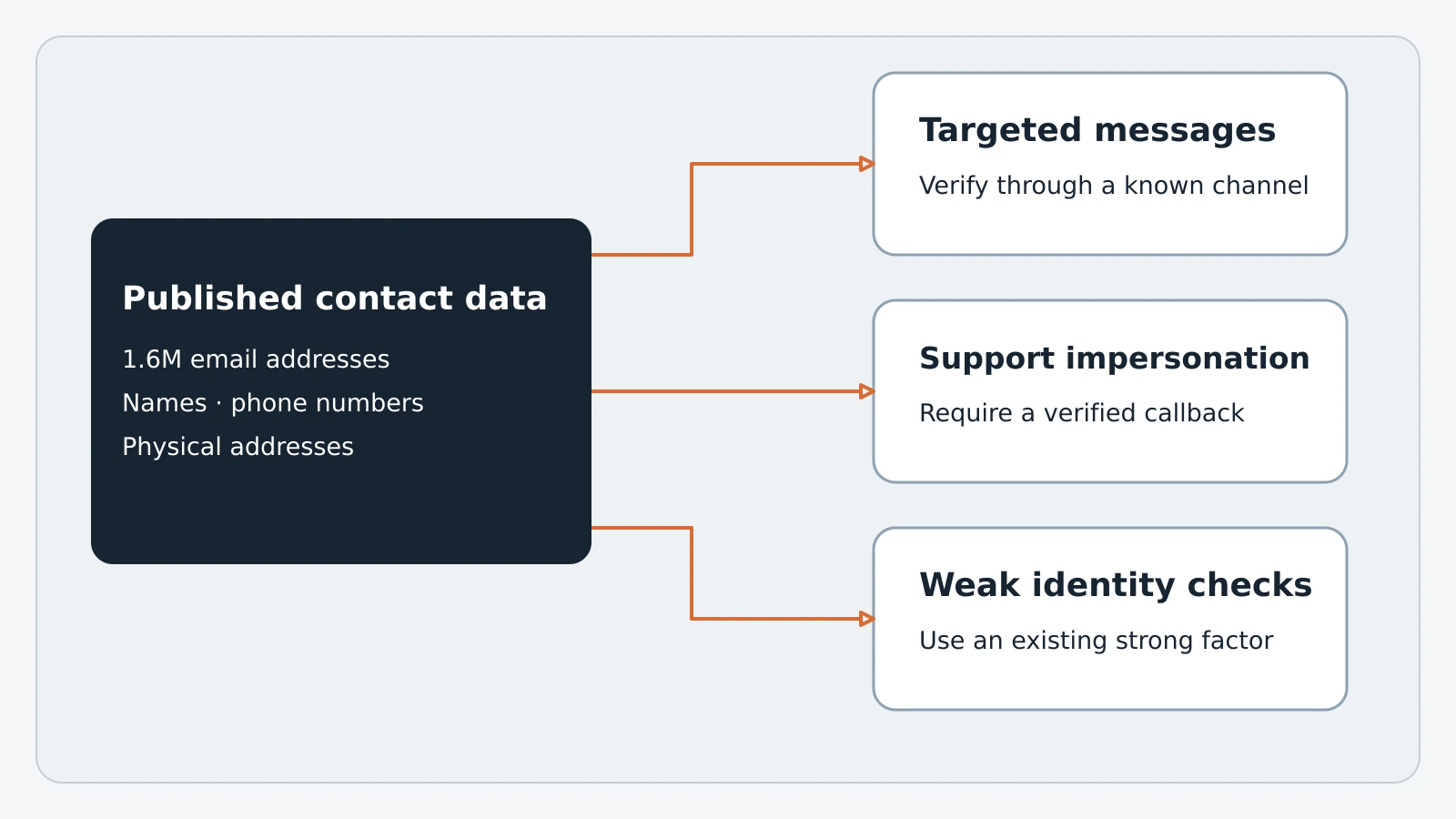
Figure details
The diagram begins with the four fields HIBP lists in the published RingCentral data: email address, name, phone number, and physical address. The data branches into targeted messages, convincing support calls, and attempts against weak knowledge-based identity checks. Each branch pairs the risk with a verification control: a known channel, a verified callback, or an existing strong factor.
The public sources do not report that these follow-on actions occurred. The leaked data changes their plausibility and gives defenders a bounded set of identity workflows to examine.
Sensitive requests need stronger proof
Start with RingCentral’s direct notification. Record which tenant or customer relationship it names, the affected data fields, and the people in scope. Treat HIBP’s field list as the public baseline while recognizing that RingCentral may provide affected customers with more specific facts.
Review help-desk and communications-admin procedures for number changes, call forwarding, voicemail resets, administrator changes, factor resets, and account recovery. Remove address, phone number, and other exposed contact data from the set of facts that can authorize a sensitive change. Require a strong existing factor or a callback through a directory entry established before the request.
Search the vulnerable interval for unusual support contacts and identity changes involving notified people. Useful records include help-desk tickets, RingCentral administrator audit events, identity-provider factor resets, mailbox rules, call-forwarding changes, and authentication alerts. Preserve the original request and the channel used to verify it.
Run a controlled help-desk test with a tester who knows only the four public field types. The expected result is that the tester cannot reset a factor, change an administrator, redirect a number, or recover an account without a stronger pre-existing authenticator or a verified callback. That result proves the exposed data cannot complete a sensitive workflow by itself.