
N-able released N-central Hotfix 2, build 2026.3.1.10, on August 6 and says self-hosted operators must install it even if they already applied Hotfix 1. The release supersedes build 2026.3.1.7 with additional hardening as threat actors evolve their techniques. For managed service providers, the affected system is not just another server: it is the control plane used to administer customer endpoints.
N-able and Huntress report active exploitation. Attackers gained administrative access to vulnerable N-central servers, used the platform’s Take Control function to reach managed Windows systems, and, according to N-able’s incident guidance, installed Cloudflare tunnels as services for persistent remote access. The public record does not establish how many partners or downstream devices were compromised.
CISA added CVE-2026-18577 to its Known Exploited Vulnerabilities catalog on August 3 and set an August 6 remediation deadline for covered federal systems. On August 4, CISA also added the original CVE-2026-18556, with an August 7 deadline. The catalog lists ransomware use as unknown for both entries; its action confirms exploitation risk, not attribution to a ransomware campaign.
The second CVE covers the path the first patch missed
N-able assigned CVE-2026-18556 to the original authentication bypass. That record covered N-central through 2026.1, and the company initially treated 2026.2 as the fixed line. It later found an alternative way to exploit the same weakness. The incomplete fix became CVE-2026-18577 and extended the affected range through 2026.3.1.
Build 2026.3.1.7 was the first release N-able identified as unaffected by the documented bypass, but it is no longer the current remediation. Hotfix 2 build 2026.3.1.10 supersedes it and is required for self-hosted deployments, including systems already running Hotfix 1. N-able says mitigations have already been applied to hosted N-central, or NCOD, environments. Self-hosted customers can upgrade directly from 2025.4, 2026.1, 2026.2, 2026.3, or 2026.3.1; older installations need an intermediate supported version.
Neither N-able nor Huntress has published the vulnerable endpoint, request sequence, or code-level root cause. That limits request-signature development. The confirmed capability is an authentication bypass that yields N-central administrative access; claims about a specific exploit payload beyond the documented post-compromise activity remain unsupported.
Console access becomes a route into every managed customer
N-central can push jobs and scripts, change accounts and policies, and open remote-control sessions on systems managed by its agents. An attacker who takes over the console inherits those administrative paths. Huntress describes Take Control as the observed bridge from the vulnerable server into downstream Windows endpoints.
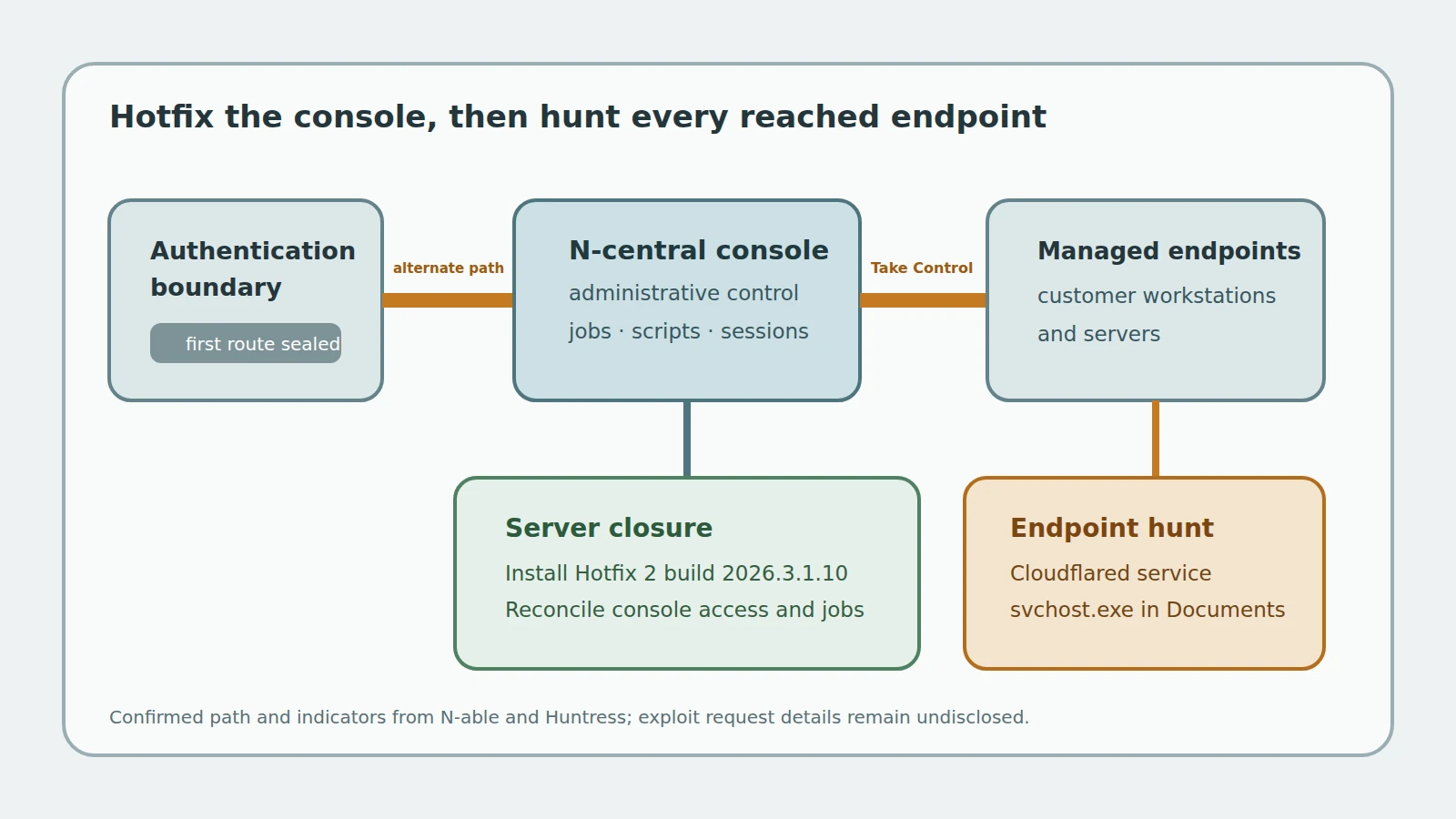
Figure details
The first patch closes one authentication route, but CVE-2026-18577 represents an alternate bypass that still reaches the N-central administrative console. N-able now requires Hotfix 2 build 2026.3.1.10 for self-hosted deployments, including those already on Hotfix 1. From that console, an attacker can use Take Control to initiate sessions on managed Windows endpoints. N-able's incident guidance identifies a Cloudflared service and an svchost.exe file under a user's Documents directory as persistence and execution pivots. Installing the server hotfix closes the exposed console path, but responders must separately inspect and clean every downstream endpoint the console could have reached.
N-able tells customers to look for a service named Cloudflared and for svchost.exe in users’ Documents folders. The filename is suspicious because the legitimate Windows Service Host normally runs from Windows system directories, not a user’s documents. A tunnel that runs as a service can reconnect outbound after a reboot without requiring an inbound firewall rule. Nothing in the disclosure indicates that Cloudflare itself was compromised; the attackers abused a legitimate tunneling service.
The server patch and the endpoint cleanup solve different parts of the incident. Hotfix 2 build 2026.3.1.10 supersedes Hotfix 1 with additional hardening at N-central. It cannot delete a service, executable, account, script, scheduled job, or remote-access foothold that an attacker already created on another machine. Treating a successful console upgrade as the end of response can therefore leave the durable part of the compromise intact.
The published indicators are pivots, not verdicts
N-able and Huntress have published ten IP addresses connected with the investigation after four addresses were added on August 6. Huntress found that several of the initial addresses are Mullvad or NordVPN exit nodes. Those addresses can carry both legitimate and malicious traffic, so an isolated match is not enough to label a session hostile or a server compromised.
Correlate N-central’s ui_access_control.log with firewall, proxy, WAF, and identity records. On managed Windows endpoints, align that activity with compressed Take Control logs under C:\ProgramData\GetSupportService_N-Central\Logs\, including BASupSrvc_*.log.gz. These files are also produced during legitimate support sessions. The useful signal is the combination: an unexplained viewer identity or source address, a session outside an approved ticket or maintenance window, and endpoint activity at the same time.
Huntress specifically advises scrutinizing apparent vendor-support identities such as [email protected], newly created administrators, privilege changes, unfamiliar scripts or broad jobs, and remote-control sessions into domain controllers, file servers, and other high-value systems. Its August 3 update says attackers prioritized key servers, typically domain controllers, requested process lists after exploitation, and moved quickly across multiple downstream hosts. Windows Application event IDs 4102, 8192, and 8193 recorded the observed MSP Support connection and Take Control session start and stop.
Huntress initially found 55.6% of reachable N-central servers in its observed partner and customer cohort unpatched. In its later August 3 measurement, that share had fallen to 13.6% overall, while 28.6% of reachable self-hosted servers remained unpatched. Those figures describe Huntress’s reachable cohort rather than all N-central deployments, but they concentrate the remaining exposure in the systems whose operators must install Hotfix 2 themselves.
Patch the server and prove the downstream estate is clean
Inventory every hosted and self-hosted N-central instance and record its exact build. Confirm self-hosted servers run Hotfix 2 build 2026.3.1.10; N-able says mitigations have already been applied to hosted instances. Restrict console access to known administrative networks or a VPN, enforce MFA for ordinary account compromise, and remember that MFA does not repair an authentication bypass.
From the earliest plausible unauthorized session through the hotfix time, export console logins, account and role changes, jobs, scripts, and Take Control sessions. Map each unexplained session to its customer and endpoint. Search those endpoints for the Cloudflared service, svchost.exe under user Documents directories, new services and scheduled tasks, unfamiliar remote tools, and network connections to the published infrastructure. Preserve the original logs before cleanup and contact N-able support when an indicator or unexplained session is found.
Resolve the incident after every self-hosted N-central server is on build 2026.3.1.10 and hosted mitigations are confirmed, all unauthorized accounts and automation are removed, every reached endpoint has been investigated and rebuilt or remediated as its evidence requires, and no unexplained Take Control or tunnel activity remains through a defined monitoring period. If console logs, endpoint logs, or customer mappings are missing, the downstream scope is still unknown.